
Middlesex County Property Tax Records
Middlesex County is the most populous county in Massachusetts and all of New England, with over 1.6 million residents spread across 54 cities and towns. Property tax records here are managed at the local level by each municipality's Board of Assessors, while deed and title records are split between two separate Registry of Deeds offices. Searching Middlesex County property records is free online through MassLandRecords.com, giving you access to documents dating back nearly 400 years.
Middlesex County Property Tax Records Overview
Middlesex County's Two-District Registry System
Middlesex County is one of the few counties in Massachusetts with two separate Registry of Deeds offices. This split goes back to the county's size and growth over the centuries. Understanding which district covers your property is the first step in any Middlesex County property records search. Getting this wrong wastes time. The two offices don't share records, so you need to know which one applies to your town.
The Middlesex North Registry of Deeds is based in Lowell and serves 10 communities in the northern part of the county: Billerica, Carlisle, Chelmsford, Dracut, Dunstable, Lowell, Tewksbury, Tyngsborough, Westford, and Wilmington. Richard P. Howe, Jr. serves as Register of Deeds. The office is at 370 Jackson Street, Lowell, MA 01852, and can be reached at (978) 322-9000. Hours are Monday through Friday, 8:30 AM to 4:00 PM. Documents must be submitted for recording by 3:30 PM. For online access to North records, visit massrods.com/middlesexnorth.
The Middlesex South Registry of Deeds covers the remaining 44 communities, including Cambridge, Newton, Somerville, Medford, Framingham, Waltham, Malden, and Everett. Maria E. Curatone serves as Register. This office is located at 208 Cambridge Street, Cambridge, MA 02141. Phone is (617) 679-6300. Research hours run Monday through Friday 8:00 AM to 4:00 PM, with recording accepted until 3:30 PM. The South Registry website is at massrods.com/middlesexsouth.
Both offices charge the same fees. Standard document recording costs $105 as a base fee plus $1 per page. Filing a Homestead Declaration runs $35. Certified copies cost $1 per page plus a $1 certification fee. Plain copies are free when you download them online.
Searching Middlesex Property Records Online
The main portal for Middlesex County property records is MassLandRecords.com. This site is free to use. No account is needed for basic searches. You can search by grantor or grantee name, property address, book and page number, recording date, or instrument number. Documents can be viewed, downloaded, and printed at no cost.
The Middlesex North district has fully digitized records going back to 1629. That means colonial-era deeds and land grants are available online. For the South district, deeds are available from 1929 forward, mortgages from 1950, and other documents from 1958. Older South district records are held at the Massachusetts State Archives. The portal covers all document types: warranty deeds, quitclaim deeds, mortgages and discharges, tax liens, mechanic's liens, easements, homestead declarations, power of attorney documents, condo plans, subdivision plans, and UCC filings.
A common mistake: some third-party companies charge $118 or more for deed copies that are entirely free at MassLandRecords.com. The official portal offers the same documents at no cost. Always go to the official site first.
Individual municipal assessor databases also let you look up assessed values, property card details, lot sizes, building characteristics, and sales history. Several Middlesex cities have their own tools: Newton uses MapGeo, Framingham also uses MapGeo, Waltham uses Patriot Properties, Malden uses Patriot Properties, and Medford uses VGSI. Lowell has a GIS search tool at gis.lowellma.gov.
Note: Research computers are not available on-site at either Registry office; all research should be done online through MassLandRecords.com before visiting in person.
Middlesex County Property Tax Assessment
Property tax assessment in Middlesex County is handled at the municipal level, not by county government. Each of the 54 cities and towns has its own Board of Assessors. They set assessed values, apply exemptions, and issue tax bills. There is no county-level tax office in Massachusetts. You deal with your local assessor for everything related to your tax assessment.
The assessment date is January 1 of each year. This is the date as of which all properties are valued for the fiscal year that begins July 1. A full revaluation is certified by the Massachusetts Department of Revenue every five years, but assessors do annual reviews and updates in between. Tax bills go out quarterly. Due dates are August 1, November 1, February 1, and May 1. Under MGL c. 59, Section 38, assessors must set values at full and fair cash value.
Key assessor offices in Middlesex County include the Cambridge Assessing Department at 795 Massachusetts Ave, (617) 349-4343, website at cambridgema.gov/assessing. Cambridge offers a notable residential exemption worth up to $499,263 in FY2026. Lowell Assessors are in City Hall Room 36, 375 Merrimack Street, reachable at 978-674-4200. The Newton Assessor's Office is at 1000 Commonwealth Ave, (617) 796-1160. Somerville Assessing is at 93 Highland Ave, (617) 625-6600 extension 3100. Framingham Assessors are at 150 Concord Street Room 101, 508-532-5415.
Property Tax Exemptions in Middlesex County
Massachusetts offers several property tax exemption programs under MGL c. 59, Section 5. These are administered locally by each Board of Assessors. All applications must be filed by April 1, or within three months after actual tax bills are mailed, whichever is later. Annual renewal is required for most programs.
Veteran exemptions cover a wide range. Clause 22 provides $400 to veterans with at least a 10% service-connected disability, Purple Heart recipients, and Gold Star Parents. Higher clauses step up to $750, $1,250, and $1,500 for more serious service-connected injuries. Clause 22D and 22F provide full exemptions for surviving spouses of service members killed or missing in action, and for paraplegic veterans. The HERO Act allows some municipalities to double these amounts. For full details on veteran exemptions, visit mass.gov veteran exemptions.
Clause 37A provides a $500 exemption for legally blind residents, as certified by the Massachusetts Commission for the Blind. Clause 17D helps elderly homeowners and surviving spouses at $234.50 or more per year. Clause 41C offers $500 or more for seniors age 70 or older who meet income and asset limits. Some towns allow 65 as the qualifying age.
Five Middlesex communities offer a residential exemption that reduces the taxable value of owner-occupied primary homes. Cambridge offers up to $499,263 in value reduction. Somerville offers up to 35% of the average assessed value. Waltham, Malden, and Everett also offer this program. Requirements are set locally, but all require the owner to occupy the property as a primary residence and apply by April 1.
The state-level Circuit Breaker Tax Credit is available to seniors age 65 and older who pay high property taxes relative to their income. It's filed with the Massachusetts income tax return and can provide significant relief for fixed-income homeowners. Contact the Massachusetts Department of Revenue for current thresholds and credit amounts.
Tax Payment Options and Due Dates
Middlesex County towns use the standard Massachusetts quarterly payment schedule. Bills are due August 1, November 1, February 1, and May 1. Most municipalities offer online payment through their websites using electronic check (ACH), often at no extra cost. Credit and debit card payments typically carry a 2 to 3 percent convenience fee. Mail-in payments by check or money order are accepted, with the postmark date counting as the payment date.
In-person payment is available at each town's Tax Collector or Treasurer office during regular business hours, which are usually 8:30 AM to 4:30 PM. Many towns also have drop boxes for after-hours payments. A few communities offer automatic direct debit enrollment for those who prefer monthly installments. Check your town's website for the specific payment portal, as processors vary by municipality. Common platforms used in Middlesex County include Invoice Cloud, City Hall Systems, and UniPay.
Late payments carry interest at 14% per annum, charged as simple interest. After one year of delinquency, a tax lien may be filed against the property. Extended nonpayment can result in tax title proceedings and eventually tax foreclosure. Staying current is far easier than resolving a tax lien.
Note: Payment due dates can shift by one or two days when a due date falls on a weekend or state holiday, so confirm the exact date with your local tax collector each quarter.
Abatement and Property Assessment Appeals
If you think your property is over-assessed, you can file for an abatement. The form to use is Form ABT, available from your local Board of Assessors and at mass.gov/dor. The filing deadline is typically April 1 of the fiscal year, but it can also be three months after actual tax bills were mailed, whichever is later. There is no fee to file. Under MGL c. 59, Section 59, assessors have three months to act on an abatement application.
When you file, bring evidence. Comparable sales of similar properties, an independent appraisal, documentation of property defects, or photos showing condition issues all help your case. The Board of Assessors reviews submissions and notifies you of their decision. If they deny your application or take no action within three months, you have 90 days to appeal to the Massachusetts Appellate Tax Board (ATB). The ATB is located at 100 Cambridge Street, Suite 200, Boston, MA 02114, phone (617) 727-3100. The appeal process at the ATB is governed by MGL c. 58A.
One important fraud protection tool is the Consumer Notification Service (CNS), available free through both Registry offices. When you sign up, you get an email alert any time a document is recorded under your name or property address. This protects against title theft, which happens when criminals file fraudulent deeds or mortgages against your property. You can register up to three properties per account. Sign up at massrods.com/middlesexnorth for North district properties or at massrods.com/middlesexsouth for South district properties. Optional text message alerts are also available.
The Middlesex County property records resource at middlesexrecords.us also provides guidance on the abatement process and links to relevant state resources. More general information about appealing your assessment is available at the mass.gov assessment appeal guide.
Registry of Deeds Resources
The official Massachusetts land records portal at MassLandRecords.com is the primary source for all Middlesex County deed and title searches, with free access to records from both registry districts.
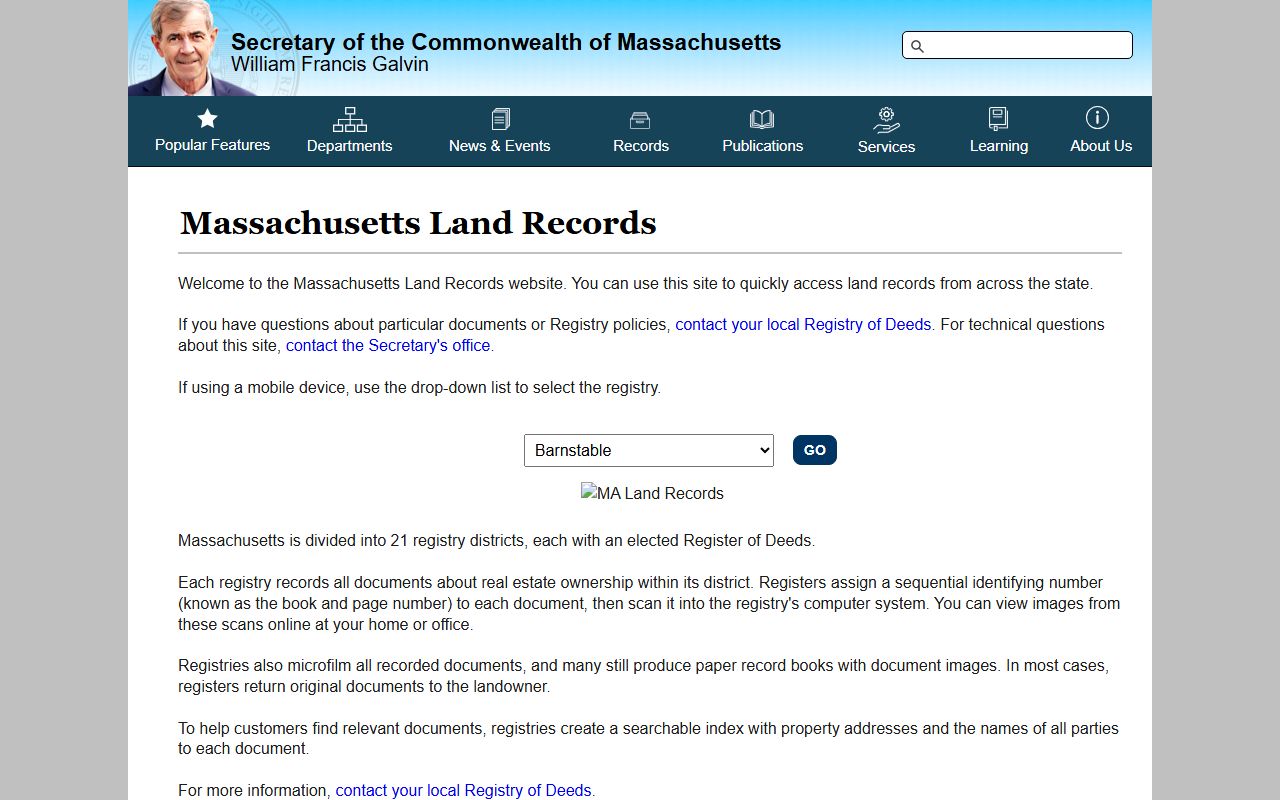
MassLandRecords.com gives you a direct search interface for both Middlesex North and South, with all documents available free to view and download.
The Middlesex North Registry website at massrods.com/middlesexnorth provides direct access to North district property records, Consumer Notification Service sign-up, and recording information for the 10 communities in the northern part of the county.
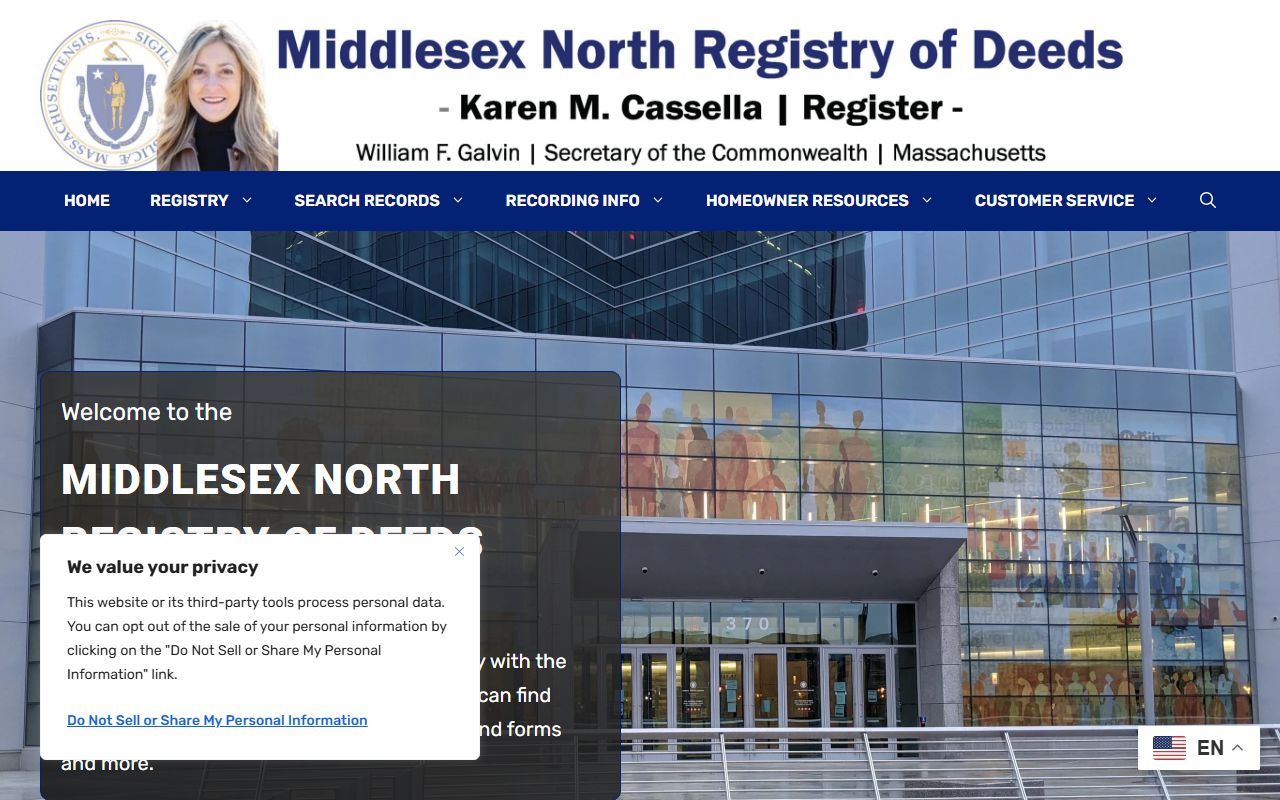
The North Registry site also lists current recording requirements, fee schedules, and contact details for the Lowell office at 370 Jackson Street.
Under MGL c. 59, Section 21C, property owners who believe their assessment is unfair can challenge the valuation through the formal abatement process. Using the free online records at MassLandRecords.com to pull comparable sales data is one of the most effective ways to build an abatement case.
Cities in Middlesex County
Middlesex County includes nine qualifying cities for property records searches. Each city has its own assessor office and online lookup tools.
Nearby Counties
These counties border Middlesex County and may be relevant if you are researching properties near county lines.