
Find Everett Property Tax Records
Everett property tax records include assessments, ownership details, residential exemption data, and tax bills for all parcels in the city. The Everett Assessors Office manages these records and offers online access through the Patriot Properties database and an ArcGIS map viewer. Middlesex South Registry of Deeds holds all deed and land records. This page explains how to search, pay, and appeal property taxes in Everett.
Everett Property Tax Overview
Everett Property Tax Search
The primary tool for searching Everett property tax records is the Patriot Properties database. You can search by address, owner name, or parcel ID. Results show assessed value, lot size, building info, sale history, and current tax data. Property record cards are also available through this system. The tool is free and open to the public. No login is required. Data is current for the active fiscal year.
The screenshot below shows the Everett Patriot Properties portal where you can look up any property in the city.
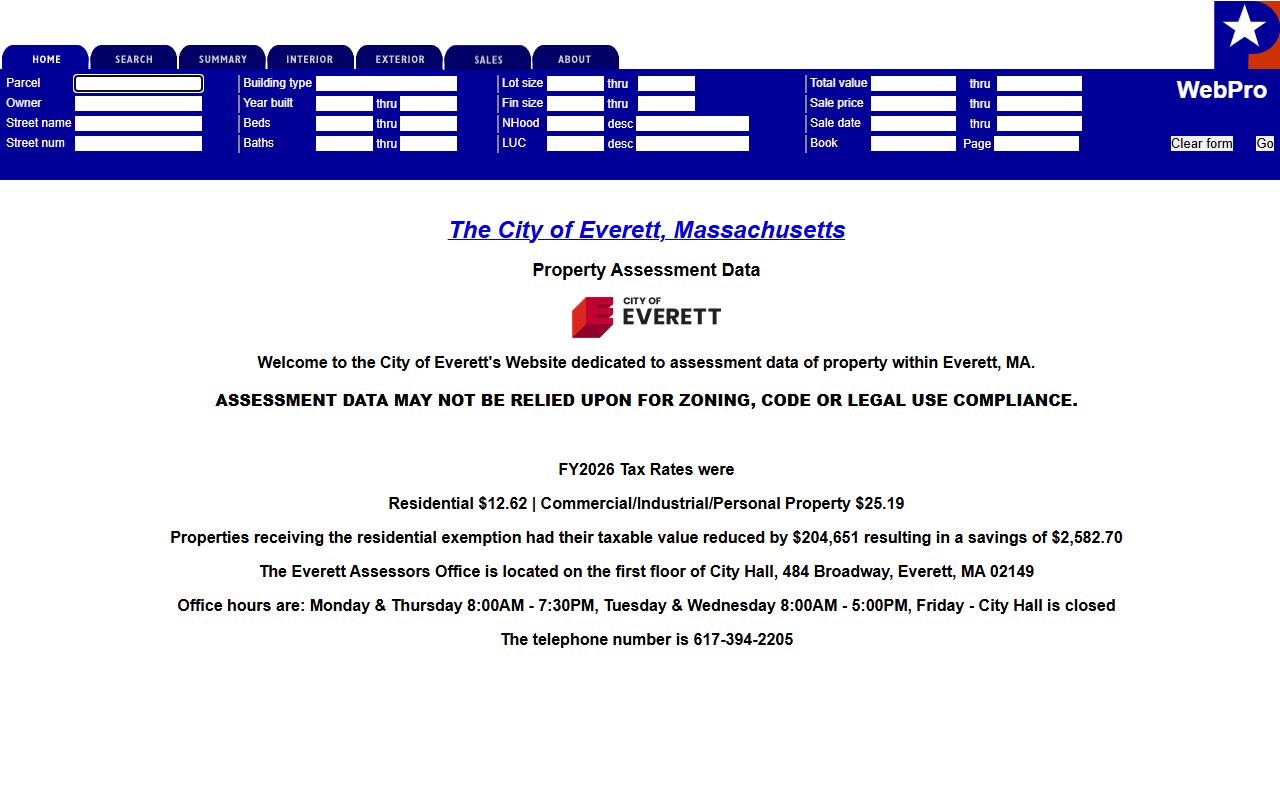
Search results include detailed breakdowns of building characteristics, land value, and improvement value for each parcel.
Everett also has a GIS mapping tool at everettma.maps.arcgis.com. This map shows parcel boundaries, zoning, and aerial photos. You can click on any parcel to see basic property data. The GIS tool is useful when you need a visual layout of a neighborhood or want to identify a parcel by location rather than address.
This image shows the Everett ArcGIS map viewer, which lets you explore parcels and zoning across the city.
The map viewer complements the Patriot Properties database by adding a spatial dimension to your property search.
For FY2024, the residential tax rate in Everett is $11.46 per $1,000 of assessed value. The commercial rate is $24.00. Under MGL c. 59, §38, all property must be assessed at full and fair cash value as of January 1 each year. Everett reviews its property values annually and adjusts them based on sales data, building permits, and market conditions. The city uses a classified tax system, which means residential and commercial properties pay different rates.
Note: Everett's FY2024 rates are shown above. Check the assessors website for the most current fiscal year rate once it is published.
Everett Assessors Office
The Everett Assessors Office is at 484 Broadway, 1st Floor, Everett, MA 02149. The phone number is 617-394-2205. The office handles property valuations, exemption applications, abatement requests, and data corrections. If you have questions about how your assessment was set, staff can explain the process and show you the comparable sales and data points they used. Office hours are Monday through Friday during standard business hours.
The assessors office sends valuation notices before each fiscal year starts. These notices show your new assessed value and give you a window to review it. If you spot errors in your property data, like wrong square footage or an incorrect building description, contact the office right away. Getting data fixed early prevents issues down the line. The office also maintains property record cards for every parcel. You can request a copy of your card to see the full breakdown of how your value was determined.
Everett's classified tax system splits the rate between residential and commercial. The city council votes on this classification each year. Commercial properties pay a substantially higher rate than residential ones. This shifts more of the tax load to businesses. The practice is common in Massachusetts cities and is permitted under state law. The assessors office posts the approved rates on the city website after each year's vote.
Everett Residential Exemption and Tax Relief
Everett offers a residential exemption that can reduce the tax bill for owner-occupied homes. The exemption removes up to 20% of the average residential assessed value before the tax rate is applied. To qualify, you must own the property and use it as your primary residence. You need to file an application with the assessors office. This exemption is one of the more generous programs available in the area and can save homeowners a significant amount each year. Not all Everett homeowners know about it, so it is worth checking if you qualify.
Beyond the residential exemption, Everett also offers standard exemptions for seniors, veterans, blind residents, and surviving spouses. The Clause 41C senior exemption can lower your bill by $1,000 or more. Veterans with disabilities receive relief ranging from $400 to a full waiver. Blind property owners get between $500 and $850 off. Surviving spouses may qualify for $234.50 in annual relief. All exemption applications are due to the assessors office by April 1. You must reapply each year for most programs. Under MGL c. 59, §5, state law lists every available exemption and its eligibility criteria.
The Massachusetts Senior Circuit Breaker Tax Credit is another option for Everett residents. This credit is worth up to $2,820 and is claimed on your state income tax return. It helps seniors aged 65 and older offset property tax costs. Everett seniors may also be eligible for the tax deferral program, which lets homeowners aged 60 and older defer all or part of their tax bill. The deferred amount accrues interest at a state-set rate and is repaid when the property is sold.
Note: The residential exemption and other exemptions can sometimes be combined. Ask the assessors office which programs stack for your situation.
Paying Everett Property Taxes
Everett property taxes are due quarterly on August 1, November 1, February 1, and May 1. Late payments trigger 14% annual interest. The city accepts online payments through cityofeverett.com. In-person payments go to Room 13 at City Hall. You can also pay by phone at 617-394-2240 or by mail to the Treasurer/Collector at 484 Broadway, Everett, MA 02149. Online credit card payments carry a convenience fee. E-check may be available at a lower cost.
If you believe your assessment is too high, file Form ABT with the assessors office. The deadline is typically 30 days after the third-quarter bill is mailed. If the assessors deny your abatement, you can appeal to the Massachusetts Appellate Tax Board. Under MGL c. 59, §21C, Proposition 2 1/2 caps the annual increase in total property tax revenue at 2.5%. Everett cannot raise more than that from one year to the next without voter approval. New growth from construction and development is added on top of the cap, which is why revenue can still grow in a building year.
Middlesex South Registry of Deeds
Deed records for Everett are filed at the Middlesex South Registry of Deeds in Cambridge. The registry handles deeds, mortgages, liens, and other land documents for the southern part of Middlesex County. Online searches are available at massrods.com. The system covers records going back several decades. Viewing is free. Certified copies require a fee paid to the registry.
When a property in Everett sells, the new deed is recorded at the registry. The assessors office then updates its ownership records to match. If you are researching a property's history, checking both the Patriot Properties database and the registry gives you the most complete picture. The registry also records homestead declarations, which cost $35 to file and protect home equity from certain creditor claims.
Nearby Cities
Several nearby cities have property tax record pages with local assessment and payment details.
Middlesex County Resources
Everett is in Middlesex County. The county page covers both the North and South registries, assessment resources, and property tax tools across the county.