
Find Property Tax Records in Norfolk County
Norfolk County property tax records go back to 1793 and cover 28 communities in eastern Massachusetts. The Registry of Deeds in Dedham holds over 13 million documents, all fully searchable online at no cost. Whether you need a deed, an assessment, or a tax rate, this guide shows you where to look and how to get what you need fast.
Norfolk County Property Tax Records Overview
Norfolk County Registry of Deeds
The Norfolk County Registry of Deeds is the central repository for all property records in the county. It is located at 649 High Street, Dedham, MA 02026. The phone number is (781) 461-6101 and the fax is (781) 461-6104. You can also reach the office by email at registerodonnell@norfolkdeeds.org. The website is norfolkdeeds.org. Register of Deeds William P. O'Donnell leads the office.
Office hours run Monday through Friday, 8:30 AM to 4:30 PM. Document recording closes at 4:00 PM. The office is closed on weekends and legal holidays. All 13.1 million documents on file are fully digitized and searchable through the online portal. Records go all the way back to 1793 when Governor John Hancock established the registry. That depth of history makes Norfolk County one of the more complete deed archives in Massachusetts.
| Address | 649 High Street, Dedham, MA 02026 |
|---|---|
| Phone | (781) 461-6101 |
| registerodonnell@norfolkdeeds.org | |
| Hours | Mon-Fri 8:30 AM - 4:30 PM; Recording until 4:00 PM |
| Register | William P. O'Donnell |
| Communities | 28 cities and towns |
Note: The Registry covers all 28 Norfolk County communities including Quincy, Brookline, Weymouth, Dedham, Needham, Norwood, Milton, and many more.
Searching Norfolk County Property Records Online
The Norfolk County Registry of Deeds website gives free access to all 13.1 million documents. You can search by owner name, address, document type, or date range. Deed images are available to view and print at no charge. For a broader statewide search, MassLandRecords.com links to the Norfolk registry and covers other Massachusetts counties as well.
For assessment data by community, each of the 28 towns maintains its own online database. Quincy uses the VGSI portal where you can search by address or parcel ID. Brookline property data is available through Patriot Properties. Weymouth offers a property viewer at weymouth.ma.us. Other towns across the county use a mix of platforms including MapGeo, VGSI, and Patriot Properties. The full assessors directory for all 28 communities is listed at norfolkdeeds.org.
The registry also has a research guide for first-time users at norfolkdeeds.org/research. If you are not sure where to start, the FAQs at norfolkdeeds.org/faqs answer the most common questions about finding deeds and related property documents.
The Norfolk County tax rates guide at Mass Bay Movers provides a useful breakdown of residential and commercial rates across the county's communities.
The tax rates table shows how FY2026 rates vary from town to town across Norfolk County, which matters when comparing property costs in different communities.
Norfolk County Property Tax Records by City
All 28 Norfolk County communities set their own tax rates each fiscal year. Under MGL c. 59, §38, all properties must be assessed at 100% of fair cash value. Each town has an independent assessor's office that handles valuation, exemption applications, and abatement requests.
Quincy is the largest city in Norfolk County. The Quincy Assessor's Office is at 1305 Hancock Street, Quincy City Hall. Phone is (617) 376-1170. For FY2026, Quincy set a residential rate of $11.78 per $1,000 and a commercial rate of $23.53 per $1,000. Property records are searchable through the Quincy VGSI portal.
Brookline has its assessor at 333 Washington Street. Phone is 617-730-2060. For FY2026, Brookline set a residential rate and also offers a residential exemption for owner-occupants. The FY2026 exemption removes $354,974 from the assessed value of qualifying properties, saving owners roughly $3,635 per year. This is one of the larger exemption programs available in Massachusetts and makes Brookline stand out among Norfolk County communities. Property searches are available at Patriot Properties.
Weymouth's Assessor is at 75 Middle Street, Weymouth Town Hall. Phone is (781) 682-3852. FY2026 residential rate is $10.12 per $1,000 and commercial is $15.85. Weymouth's rate is one of the lower ones in the county. The town offers a property viewer at weymouth.ma.us.
Norfolk County Property Tax Exemptions
Property tax exemption programs in Norfolk County are governed by MGL c. 59, §5, which outlines all of the exemption types available to Massachusetts property owners. Each of the 28 communities administers these programs through its own assessor's office. Most exemptions require an application filed by April 1 for the current fiscal year.
Senior exemptions under Clause 41C are available in all Norfolk County communities for residents age 65 or older who meet income and asset thresholds. The Circuit Breaker Tax Credit is a state income tax program that can provide up to $2,820 for seniors who pay high property taxes relative to their income. Veteran exemptions range from $400 for partial disability up to a full exemption for veterans with 100% disability ratings. More detail on veteran programs is at the Massachusetts DOR veteran exemption page.
Brookline is the only qualifying city in Norfolk County that offers a residential exemption. The program reduces the assessed value for owner-occupants by $354,974 in FY2026, which saves roughly $3,635 on the annual tax bill. To apply, contact the Brookline Assessor by the April 1 deadline. Other Norfolk County towns do not offer a residential exemption, so Brookline's program is a notable benefit for owner-occupants in that community.
Note: Exemption income and asset limits change periodically; check with your local assessor each year to confirm the current thresholds before applying.
Consumer Notification Service and Fraud Protection
The Norfolk County Registry of Deeds offers a free service that alerts you when a document is recorded against your property. Called the Consumer Notification Service, it sends an email whenever a deed, mortgage, lien, or other document is filed under your name. This is one of the more useful free tools the registry provides, especially for homeowners worried about deed fraud or unauthorized transfers.
Signing up is free and takes only a few minutes. You provide your name and email address, and the system watches for new recordings. If anything comes in under your name, you get an alert right away. You can sign up at norfolkdeeds.org. The same page also explains how to request a correction if a fraudulent document is recorded.
The Massachusetts DOR interactive property map gives a statewide view of assessment data and is a useful tool for comparing Norfolk County values with those in other counties.
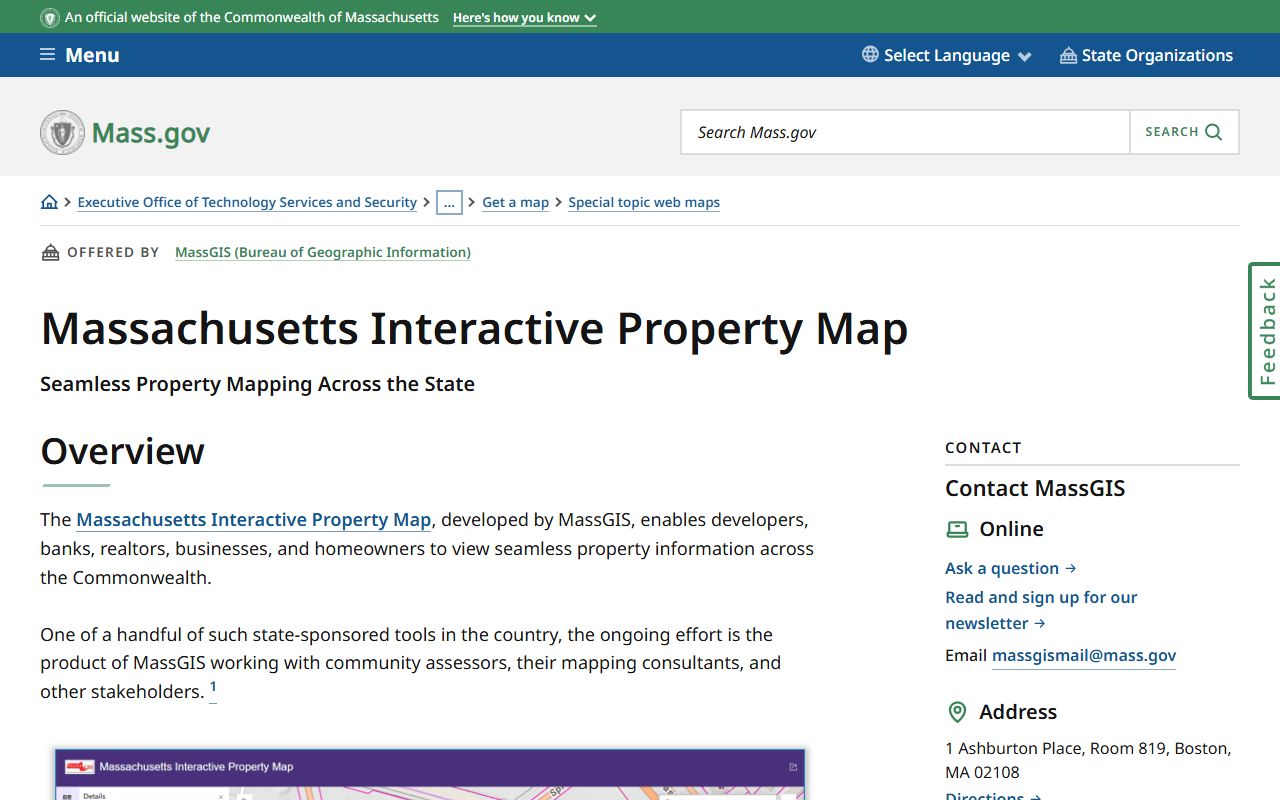
The DOR interactive map at mass.gov overlays assessment data across all Massachusetts communities, including all 28 Norfolk County towns, letting you compare values across town lines.
Tax Payments, Late Interest, and Abatements
Norfolk County property taxes follow the same statewide quarterly billing cycle as all Massachusetts communities. Bills are due August 1, November 1, February 1, and May 1 each year. Each of the 28 towns handles its own billing and accepts online, mail, and in-person payments. Check your town's website for the specific payment portal or mailing address.
Late payments accrue interest at 14% per year from the due date. That rate is fixed by state law and does not vary from town to town. If taxes go unpaid for an extended period, the town can place a tax lien on the property. Most communities send notice before filing a lien, but the interest continues to build until the balance is paid in full.
If you believe your assessment is too high, you can file for an abatement using Form ABT. The deadline is April 1 under MGL c. 59, §59. Your local assessor must act on the request within a set time. If they deny it or do not act, you can appeal to the Appellate Tax Board under MGL c. 58A. The ATB is the state agency that hears these disputes for all Massachusetts communities including every Norfolk County town.
Recording Documents and Homestead Protection
The Norfolk County Registry records deeds, mortgages, liens, easements, plans, and other property documents for all 28 communities. The standard recording fee is $105 for the base document plus $1 per page. A Declaration of Homestead costs $35. Certified copies are $1 per page plus $1 for the certification. All fees are payable at the Dedham office in person or by mail.
Filing a Declaration of Homestead under MGL c. 59, §21C protects your primary residence from certain forced sales. Once recorded, the protection applies to all equity in your home up to the statutory limit. It stays in place until you sell, transfer, or formally revoke it. The registry's homestead page at norfolkdeeds.org/homestead explains the process and what documents you need to bring.
Note: You can record a homestead declaration in person at 649 High Street in Dedham or mail it with a check payable to the Register of Deeds.
Cities in Norfolk County
Norfolk County has 28 communities. The qualifying cities below have their own dedicated property tax records pages.
Nearby Counties
These counties border Norfolk County and have their own property tax records pages.