
Search Boston Property Tax Records
Boston property tax records cover assessments, ownership, exemptions, and tax bills for all property in the city. The Boston Assessing Department maintains these records and makes them searchable online through the city's property lookup portal. Whether you want to check an assessed value, look up a tax bill, or find out what exemptions apply to a parcel, this guide covers how to find and use Boston property tax records.
Boston Property Tax Records Overview
Boston Property Tax Record Search
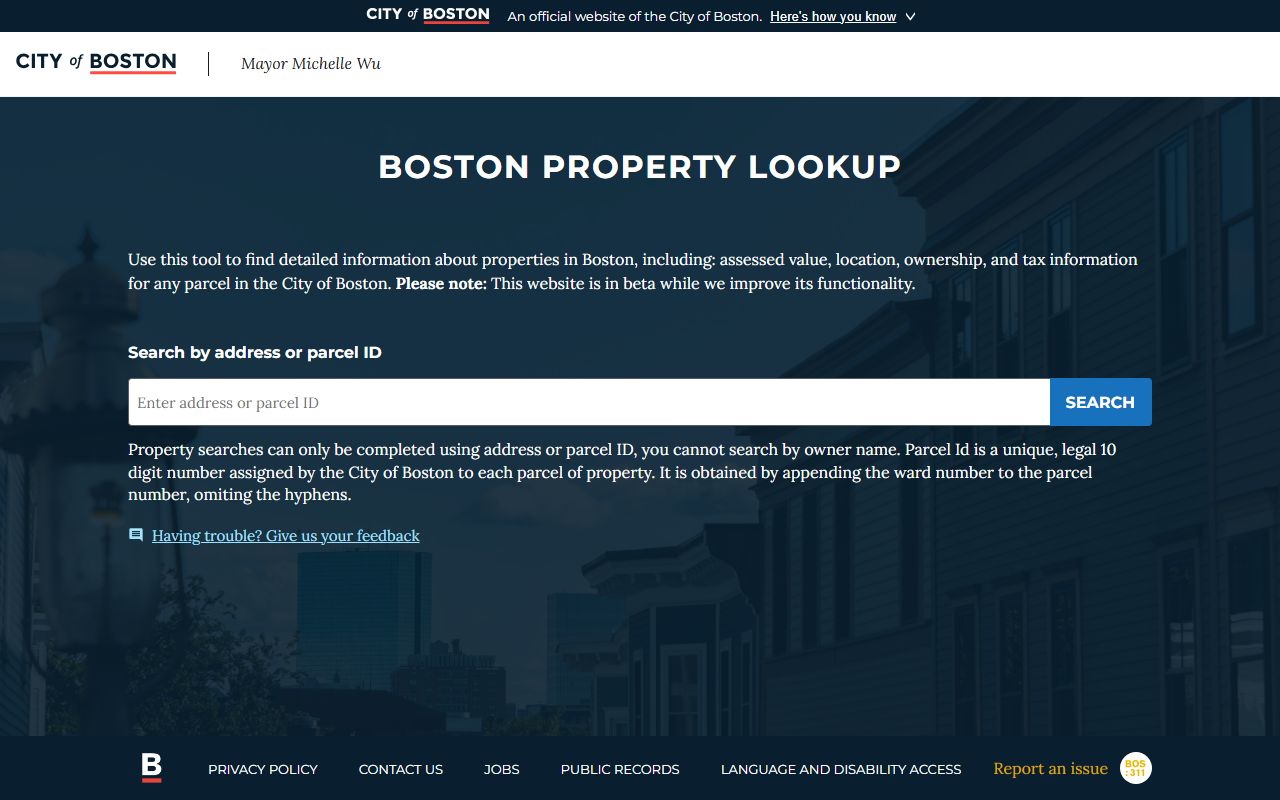
The main tool for searching Boston property tax records is the Boston Property Lookup, also accessible at properties.boston.gov. You can search by address, parcel ID, or owner name. Results show assessed value, tax amount, property details, exemption status, and sales history. This is the fastest way to find up-to-date assessment and tax data for any Boston parcel.
For property owners who want to dig into the data further, the city also maintains a full open data portal. The Boston open data site at data.boston.gov lets you download full assessment datasets in CSV or Excel format. The datasets include all assessed values, tax classifications, and parcel attributes for the entire city. Researchers, developers, and property owners all use this resource. You can pull data going back multiple fiscal years to track how values have changed.
Boston also has an interactive GIS mapping system at btmaps.com. The map shows parcel boundaries, zoning, aerial imagery, and street views. You can click any parcel to see its basic data. This is useful when you want a visual picture of a neighborhood or need to identify a parcel by its location rather than its address.
The screenshot below shows the Boston Property Lookup portal at the Boston Assessing search page, where you can enter an address or owner name to pull up full property tax records.
The city updates property records throughout the year. Assessed values are set as of January 1 each year for the upcoming fiscal year.
Boston Assessing Department
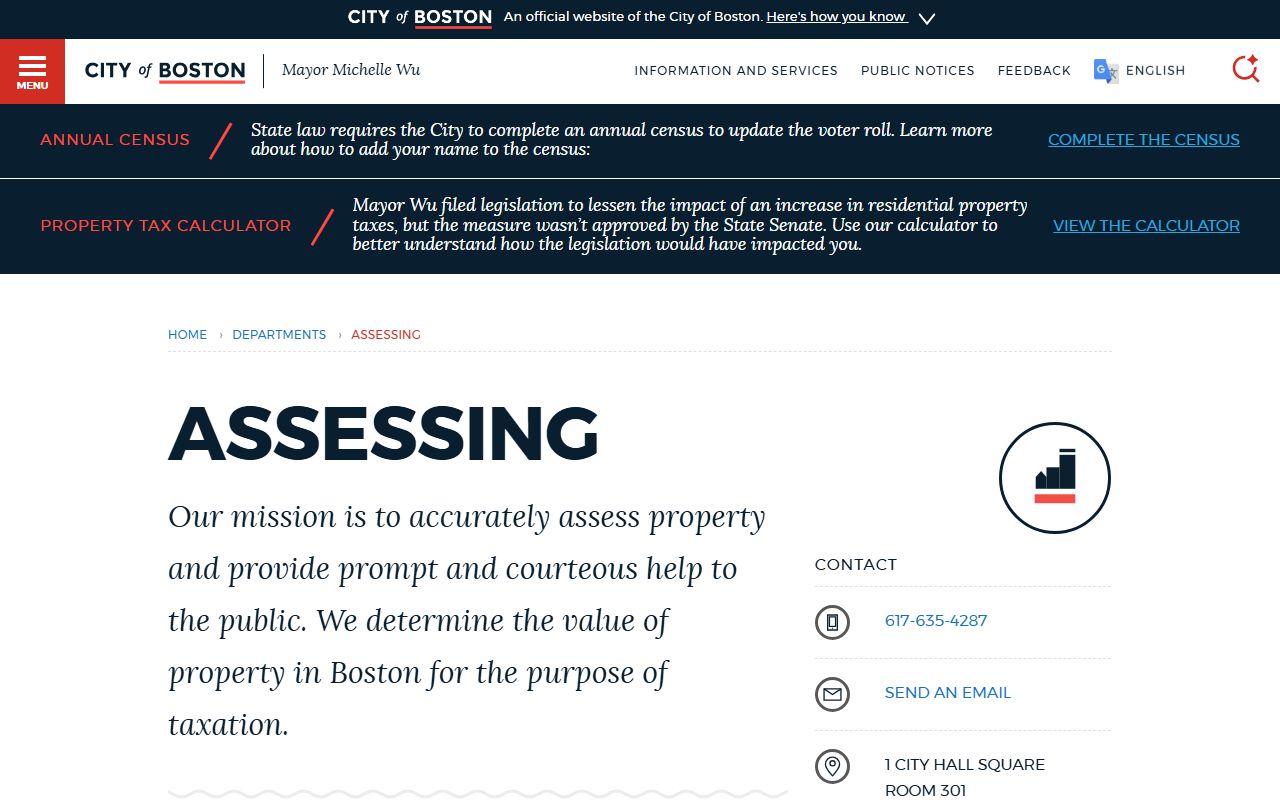
The Boston Assessing Department sets assessed values for all property in the city and handles all questions about your assessment, tax classification, exemptions, and appeals. Staff are available Monday through Friday, 9 AM to 5 PM. The office is at Room 301, 1 City Hall Square, Boston, MA 02201. You can reach them by phone at 617-635-4287 or by email at assessing@boston.gov.
The image below is from the Boston Assessing Department website, which lists all services, forms, and contact information for property owners.
The department posts assessment data, reports, and downloadable files at boston.gov/departments/assessing/property-data-and-reports.
Boston uses a classified tax system, which means residential and commercial properties are taxed at different rates. For FY2026, the residential rate is $12.40 per $1,000 of assessed value. The commercial rate is $26.96 per $1,000. Tax bills go out on a quarterly schedule, with payments due August 1, November 1, February 1, and May 1 each year. Under MGL c. 59, §38, assessors must assess all property at full and fair cash value as of January 1 each year. This is the legal basis for how Boston determines what each property is worth.
Note: For questions about tax bills or payment status, contact the Tax Collection office at 617-635-4136, not the Assessing Department.
Boston Residential Exemption
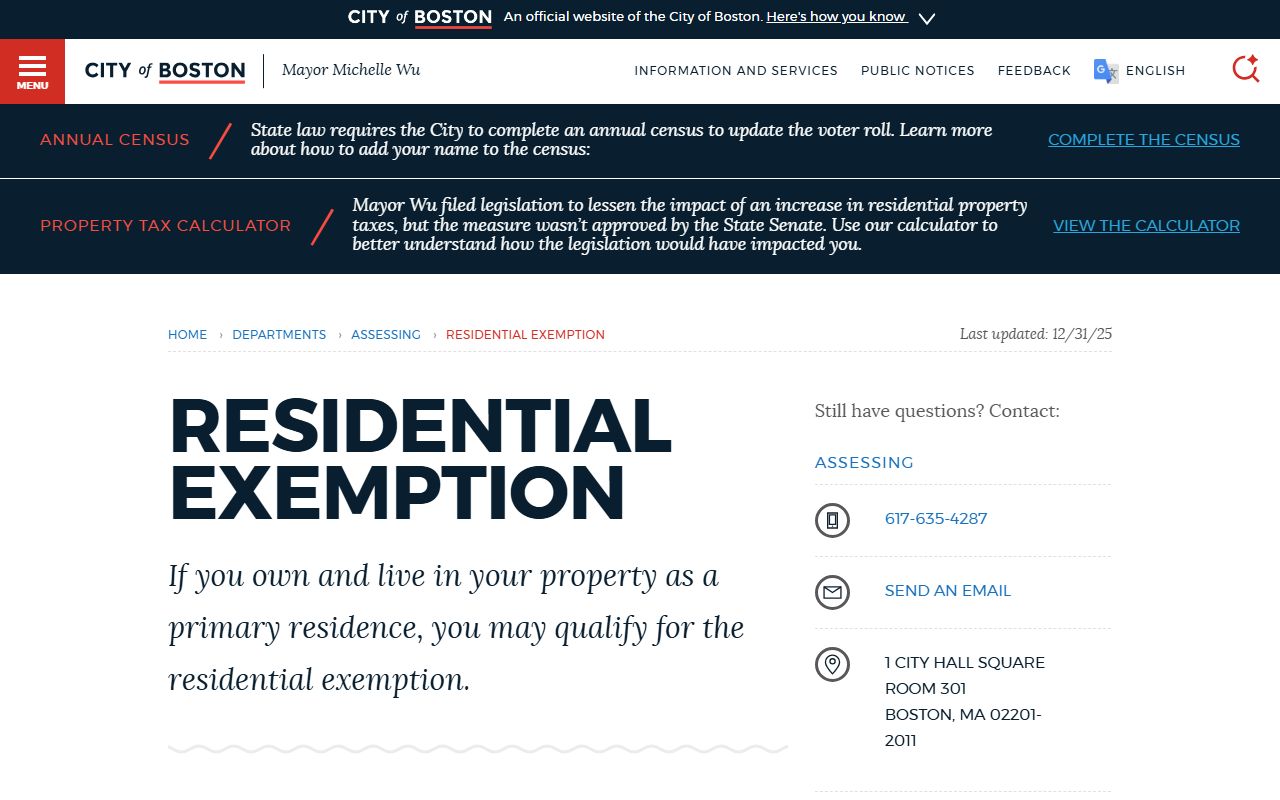
Boston's residential exemption is one of the most valuable property tax benefits in the state. For FY2026, the exemption removes up to $351,108 from the assessed value of your home before the tax rate is applied. That can save you up to $4,353.74 on your annual tax bill. To qualify, you must own the property and use it as your primary residence. You must file Form RES with the Assessing Department by April 1 each year. The exemption does not carry over automatically and must be renewed annually.
The screenshot below comes from the Boston residential exemption page, where you can find the application form and full eligibility rules.
Many Boston homeowners qualify but never apply. If you own and live in your home, check the exemption page each year before April 1.
Beyond the residential exemption, Boston also offers other programs for eligible property owners. Elderly homeowners may qualify under Clause 41C for a reduction of $1,000 or more. Veterans may receive an exemption ranging from $400 to a full tax waiver, depending on disability status. Blind property owners may receive between $437 and $500 in relief. Surviving spouses may qualify for Clause 17D relief of $234.50 or more. The Massachusetts Senior Circuit Breaker Tax Credit offers up to $2,820 for qualified seniors, and is filed through the state income tax return. Under MGL c. 59, §5, the state law lists all property tax exemptions available in Massachusetts and sets the rules for each one. All exemption applications go to the Boston Assessing Department by April 1.
Tax Payment and Late Fees
Boston property taxes are billed quarterly. Bills are due on August 1, November 1, February 1, and May 1. Missing a due date triggers interest charges of 14% per year. If taxes go unpaid for more than one year, the city can place a tax lien on the property. That lien can eventually lead to a tax title proceeding, which puts the property at risk.
There are several ways to pay. Online payments go through the InvoiceCloud portal at boston.invoicecloud.com. E-check payments are free; credit and debit card payments carry a 2.75% convenience fee. You can also pay by phone at 855-731-9898. In-person payments are accepted at the City Hall Mezzanine at 1 City Hall Square, Monday through Friday 9 AM to 5 PM. Mailed payments go to City of Boston, P.O. Box 846028, Boston, MA 02284-6028. Make sure your payment arrives by the due date, not just postmarked by it.
If you believe your assessment is too high, you can appeal. Boston's appeals process starts with the Assessing Department. Details are at boston.gov/departments/assessing/appeals. Under MGL c. 59, §59, you have the right to file for an abatement if your assessment is too high, and you must do so within a specific window after bills are issued.
Suffolk County Registry of Deeds
Property tax records tie closely to deed records at the Suffolk County Registry of Deeds. The registry tracks ownership changes, which affect how properties are assessed. When a property sells, the registry records the deed and the assessing department may update the assessed owner accordingly.
You can search Suffolk County deed records online through MassLandRecords.com/suffolk. This system covers deeds from 1949 to the present. Older records may require an in-person visit or contact with the registry. The registry maintains records for Boston and all other cities and towns in Suffolk County.
The MGL c. 59, §21C statute governs the assessment appeals process for overvaluation claims. If you feel your property has been assessed above its fair market value, this is the section of law that applies. You start with the local assessors and can escalate to the Appellate Tax Board if needed.
Note: Deed searches on MassLandRecords are free to view. Certified copies require a fee paid directly to the registry.
Nearby Cities
Other cities near Boston also maintain property tax records through their local assessing departments.
Suffolk County Resources
Boston sits in Suffolk County. The county-level page has more detail on assessment practices, registry resources, and property tax tools across the county.