
Quincy Property Tax Records
Quincy property tax records contain assessment data, ownership information, tax billing details, and exemption status for all parcels in the city. The Quincy Assessors Department maintains roughly 27,000 parcels and provides online access through its VGSI property search tool. Located just south of Boston in Norfolk County, Quincy has a classified tax system with separate residential and commercial rates. This guide covers how to search property records, understand your tax bill, and apply for available exemptions.
Quincy Property Tax Overview
Search Quincy Property Data
The Quincy VGSI Property Search is the main tool for looking up property tax records in the city. You can search by owner name, address, or parcel ID. Each result shows the assessed value, property class, lot size, building details, and recent sales data. The tool is free to use and does not require an account.
The system breaks out land value and building value separately, which is useful if you want to understand what portion of your assessment comes from the structure versus the lot. You can also view property record cards that show more detailed information about the building, including square footage, year built, condition, and style. This level of detail helps when you are comparing your property to others in the area.
The screenshot below shows the Quincy VGSI search portal, where you enter an address or name to pull up assessment records.
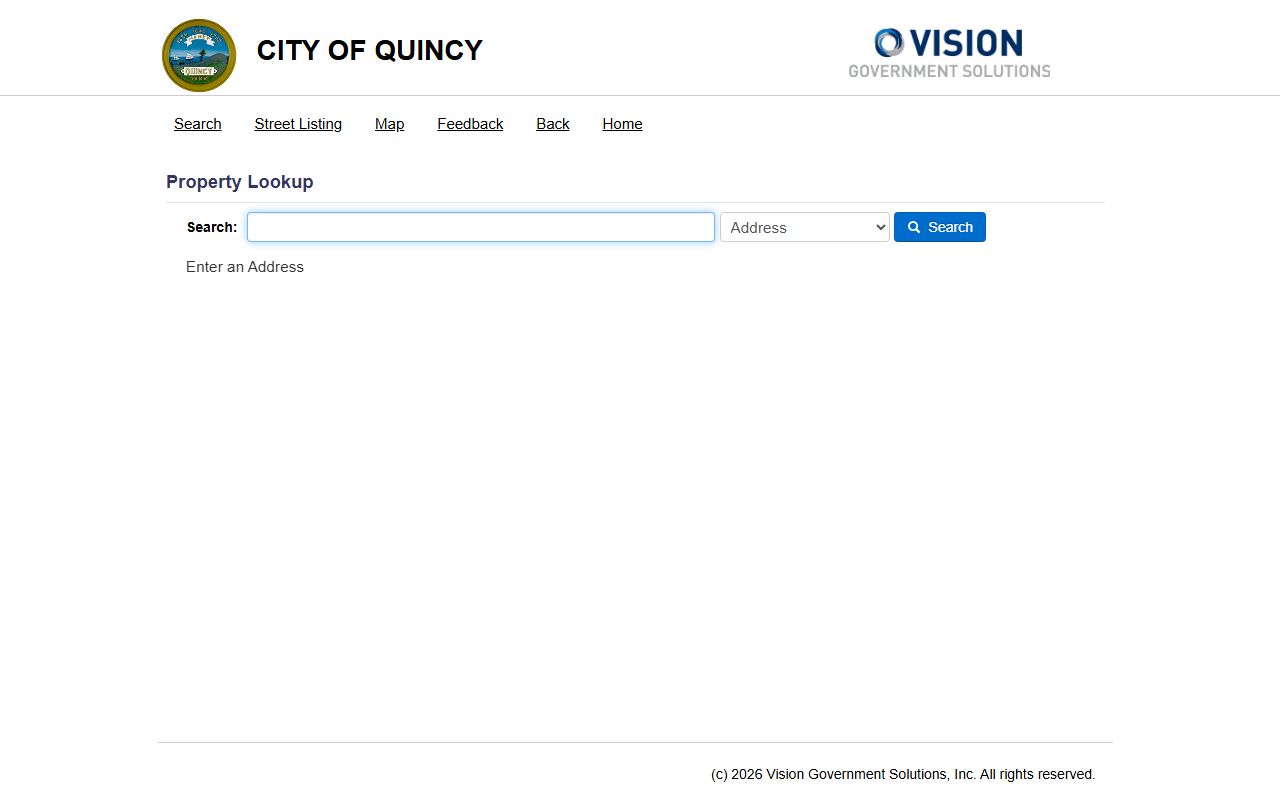
Results load quickly and show the most recent fiscal year data.
Quincy Assessors Department
The Quincy Assessors Department is at 1305 Hancock Street in Quincy City Hall. You can call them at (617) 376-1170. The department sets assessed values for all property in the city and processes exemption applications. Staff can answer questions about how your value was determined and walk you through the appeals process if needed.
Quincy uses a classified tax system. For FY2026, the residential rate is $11.78 per $1,000 of assessed value and the commercial rate is $23.53 per $1,000. Under MGL c. 59, §38, assessors must value all property at full and fair cash value as of January 1 each year. The city reassesses properties on a regular cycle and adjusts values to reflect market conditions. With about 27,000 parcels to manage, the department has a substantial workload and relies on both field inspections and sales data analysis to keep values accurate.
Quincy's proximity to Boston means property values can shift quickly, especially in areas near transit stations and the waterfront. A home assessed at $500,000 would owe about $5,890 in residential taxes at the current rate. Commercial owners face nearly double that rate on their assessed values.
Note: For questions about tax bill payments or balances, contact the Tax Collector at City Hall, not the Assessors Department.
Payment Options and Deadlines
Quincy property taxes are billed quarterly, with due dates on August 1, November 1, February 1, and May 1. You can pay online at quincyma.gov/payments. E-check payments are free. Credit and debit card payments carry a convenience fee. In-person payments are accepted at City Hall, 1305 Hancock Street. Mailed payments also go to that address.
Missing a due date triggers interest of 14% per year on the unpaid balance. This rate is set by state law. If taxes stay unpaid for an extended period, the city can place a lien on the property and begin tax title proceedings. Quincy takes collection seriously, so stay on top of your due dates. If you are facing a hardship, contact the collector's office before the bill comes due to see what options might be available.
The Proposition 2 1/2 law under MGL c. 59, §21C limits how much the city can raise its total tax levy each year. The cap is 2.5% plus new growth. This means even as property values rise, the total amount Quincy can collect from all taxpayers grows at a controlled rate. Individual bills may go up or down depending on how your property's value changed relative to others.
Exemptions and Tax Relief Programs
Quincy offers several property tax exemptions for qualifying residents. Elderly homeowners may apply under Clause 41C for a reduction based on income and asset limits. Veterans with a service-connected disability can get exemptions that range from a few hundred dollars to a full tax waiver. Blind residents and surviving spouses also have dedicated exemption programs. Under MGL c. 59, §5, the state law authorizes all of these exemptions and sets the eligibility rules that cities must follow.
All exemption applications go to the Assessors Department by April 1 each year. You must own and occupy the property as your primary residence to qualify for most programs. The state's Senior Circuit Breaker Tax Credit is also available, offering up to $2,820 for qualifying seniors through their state tax return. This is a separate program that does not require a city application.
If your assessment seems too high, file Form ABT for an abatement. The deadline is April 1 or three months after bills are mailed, whichever is later. Under MGL c. 59, §59, you have the right to request a reduction if the assessed value exceeds fair market value. Denied abatements can be appealed to the Appellate Tax Board.
Norfolk County Registry of Deeds
Property deed records for Quincy are maintained at the Norfolk County Registry of Deeds in Dedham. The registry records deeds, mortgages, liens, easements, and other documents that affect property ownership and title. When a sale closes, the new deed is recorded here and that information eventually flows to the city assessors.
You can search the Norfolk County Registry online for free. The database contains more than 13.1 million documents dating back to 1793. That makes it one of the most comprehensive registries in the state. For Quincy property owners, the registry is useful for verifying ownership, checking for liens or encumbrances, and tracing the history of a parcel through its deed chain.
The screenshot below shows the Norfolk County Registry of Deeds website, where you can search deed records for Quincy and other Norfolk County communities.
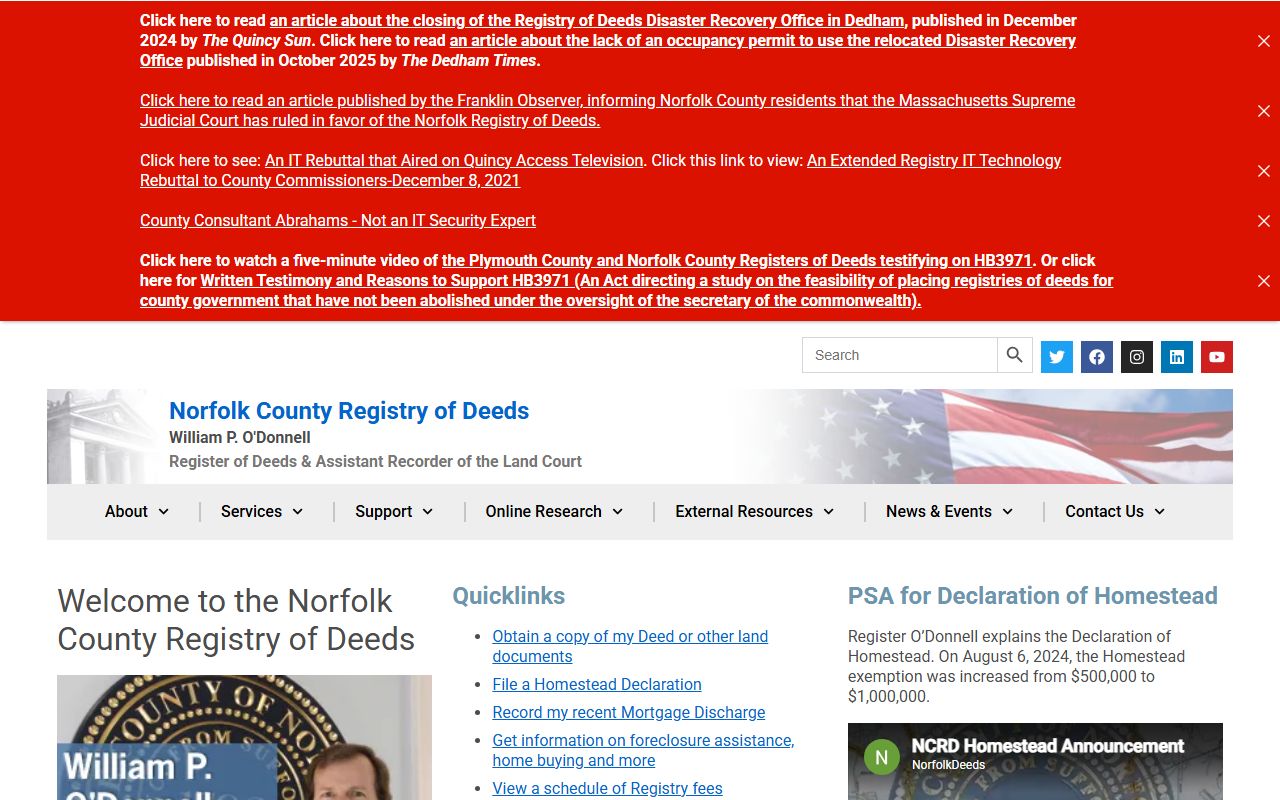
Online searches are free. Certified copies of documents require a fee paid to the registry.
Nearby Cities
Several qualifying cities are near Quincy, all with their own property tax records and assessment departments.
Norfolk County Resources
Quincy is in Norfolk County. The county page covers registry details, assessment practices, and property tax resources across all Norfolk County communities.