
Franklin County Property Tax Records
Franklin County property tax records are kept by 26 separate town assessors spread across western Massachusetts. You can search deed records online through the Franklin County Registry of Deeds and look up assessed values through individual town portals. The county seat is Greenfield, where most deed recording takes place. This page walks you through the best ways to find Franklin County property tax data, check current rates, and learn about local programs like CPA surcharges that affect what owners pay. Rural towns here handle things a bit differently than bigger counties, so the steps below keep it simple.
Franklin County Property Tax Overview
Franklin County Registry of Deeds
The Franklin County Registry of Deeds is at 43 Hope Street in Greenfield. It stores all real property documents for the 26 towns in the county. Register Scott A. Cote runs the office. The phone number is (413) 772-0239, and you can email franklinrod@sec.state.ma.us with questions about recorded documents. Office hours are Monday through Friday, 8:30 AM to 4:30 PM, with document recording accepted until 4:15 PM.
Records here go back to 1787. That is one of the older collections in the state, though not quite as far back as some eastern counties. Online access through MassLandRecords.com covers documents from about 1900 forward. You can view deed images, mortgage records, and other land documents for free. Certified copies still require a trip to the office or a written request by mail. For anything before 1900, you will need to visit in person or contact the Massachusetts State Archives.
The registry website at franklindeeds.com has current hours, fee schedules, and links to search tools. It is the best place to start when you need to look up a deed or check ownership history in Franklin County.
| Address | 43 Hope St, Greenfield, MA 01301 |
|---|---|
| Phone | (413) 772-0239 |
| franklinrod@sec.state.ma.us | |
| Hours | Mon-Fri 8:30 AM - 4:30 PM; Recording until 4:15 PM |
| Register | Scott A. Cote |
The Franklin County Registry of Deeds homepage shows the main portal where property owners and title researchers start their searches for recorded land documents.
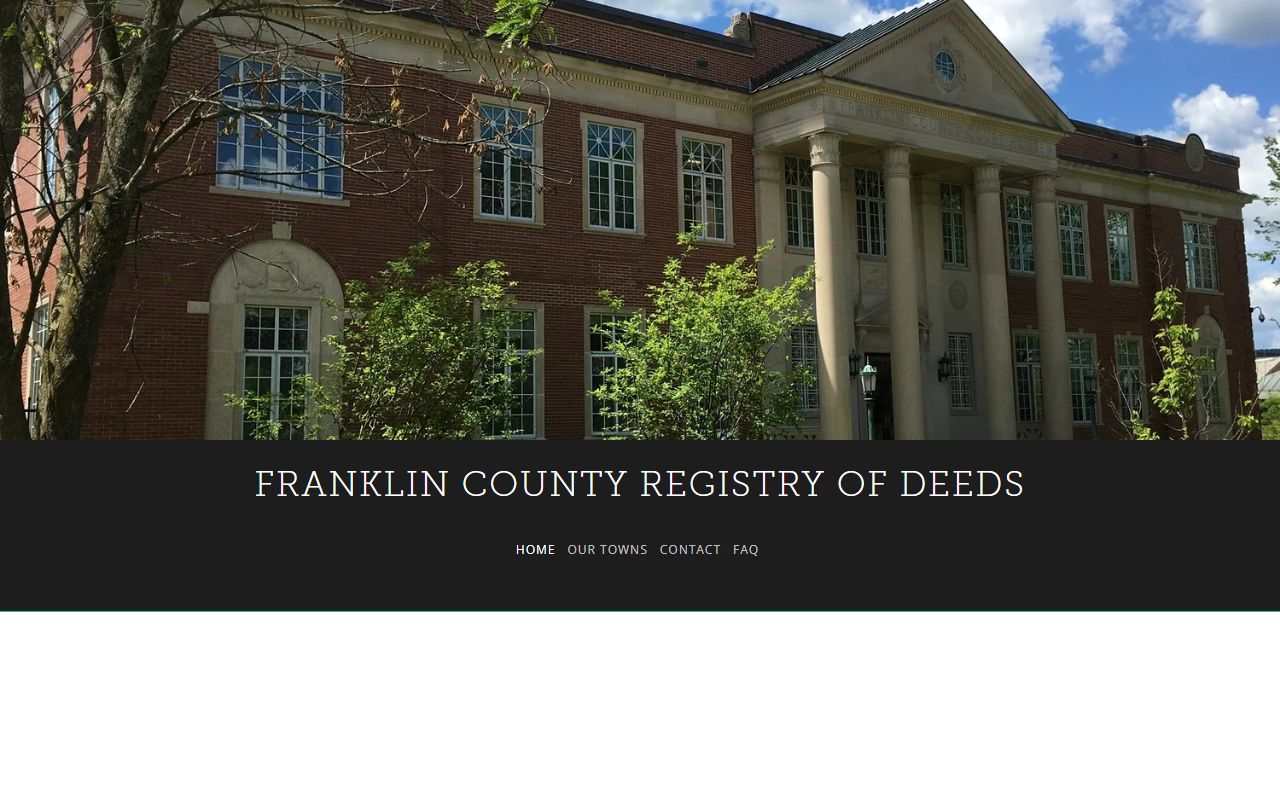
From this page you can link out to the MassLandRecords search tool, find office hours, and get details on recording fees for Franklin County deeds.
Franklin County Property Tax Search Tools
There is no single countywide property tax search for Franklin County. Each of the 26 towns runs its own assessor's office and most offer some form of online lookup. Greenfield, the largest town, has its property data available through an online GIS and assessment portal. You can search by address or parcel ID to pull up assessed values, lot sizes, building details, and owner names. It is free to use and updated each fiscal year.
For other Franklin County towns, many use the Vision Government Solutions (VGSI) database at vgsi.com. You pick the town from a dropdown list and then search by name or address. Not every town participates, but a good number of the smaller Franklin County communities show up there. The data includes assessed values, property class, and basic building info.
The Greenfield GIS assessment portal lets you look up parcels on a map and view detailed property tax and assessment records for properties in the town of Greenfield.
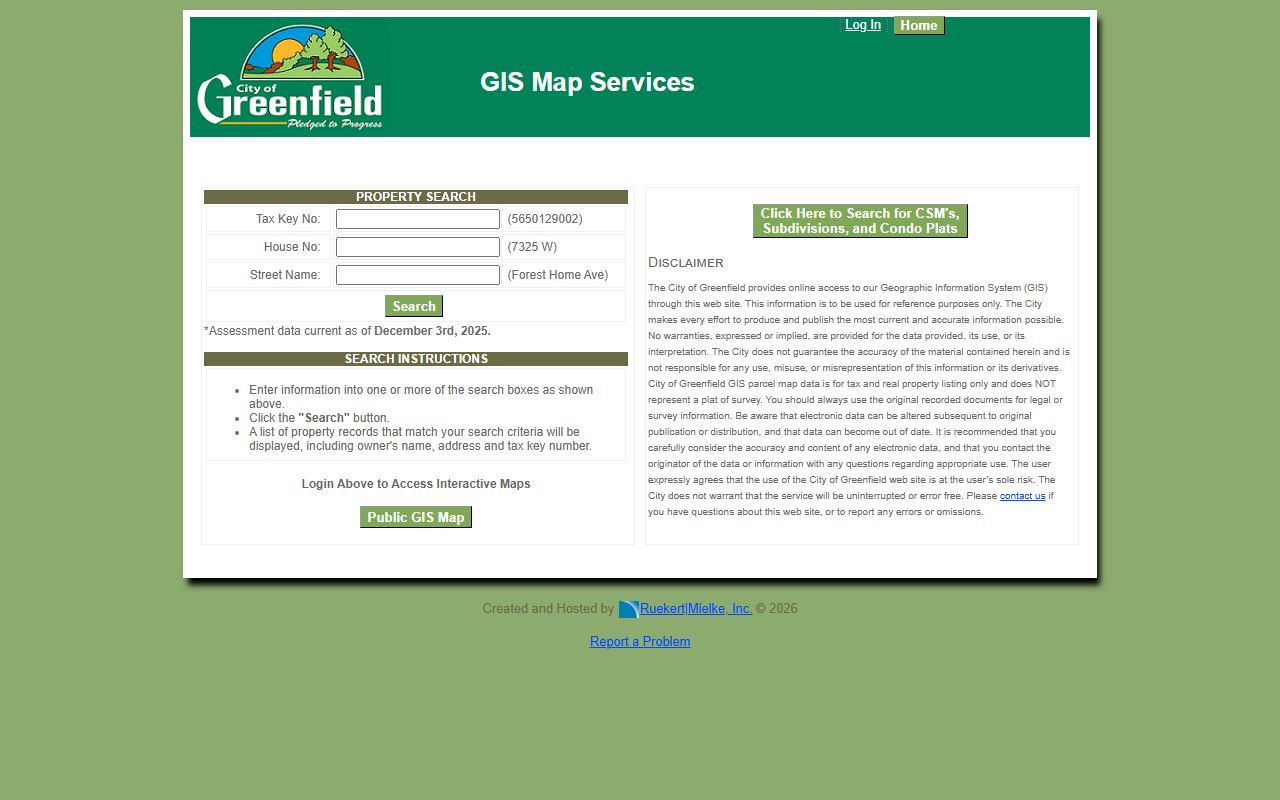
The map view is useful for checking lot lines and seeing nearby parcels, while the data panel shows the assessed value and tax information for that parcel.
Note: Some smaller Franklin County towns may not have online assessment data, so call the town assessor directly for those records.
Greenfield Assessor and Tax Rates
The Greenfield Assessor's Office is located at 14 Court Square in Greenfield. The phone number is (413) 772-1500. This office handles assessments for all taxable property within the town of Greenfield. As the county seat and most populated town, Greenfield tends to set the tone for how people think about Franklin County property taxes.
Franklin County tax rates vary quite a bit from town to town. Rural communities with less commercial property often have higher residential rates because the tax burden falls almost entirely on homeowners. Towns closer to Greenfield or along the Interstate 91 corridor tend to have more balanced tax bases. You can view a comparison of all 26 town rates on the Franklin County tax rate comparison page, which lists current and historical rates for each community. This is a helpful tool if you are comparing costs across towns before buying property in the area.
All Franklin County towns must assess property at 100% of fair cash value. That is a state requirement under MGL c. 59, §38. The Department of Revenue certifies each town's values on a rolling basis, and towns must complete a revaluation at least every three years. If a town falls behind on this, the state can step in.
The Franklin County tax rate comparison page shows a side-by-side list of residential and commercial tax rates for all 26 towns in the county.
This chart makes it easy to spot which Franklin County towns have the highest and lowest rates and how they have changed in recent years.
Tax Exemptions in Franklin County
Franklin County property owners can qualify for several tax exemptions under state law. These programs are handled at the town level, so you file with your local assessor. The most common exemptions fall under MGL c. 59, §5, which lists dozens of categories. Senior homeowners age 65 and older may qualify for Clause 41C, which provides at least $1,000 off the tax bill. Veterans with service-connected disabilities get relief under several clauses, ranging from $400 to full exemption depending on disability level. Blind residents get $437 to $500 under Clause 37A. Surviving spouses can receive at least $234.50 under Clause 17D.
The Senior Circuit Breaker tax credit is a state income tax benefit worth up to $2,820 for seniors who spend more than 10% of their income on property taxes or rent. This applies to all Franklin County residents who meet the age and income limits. It is claimed on your state income tax return, not through the town assessor.
The filing deadline for local exemptions is April 1. Start early. Gather proof of income, age, and residency before you visit the assessor's office. Some towns may have additional local exemptions, so it is worth asking when you file.
CPA Surcharge and Chapter 61 Programs
Nine Franklin County towns have adopted the Community Preservation Act. Those towns are Conway, Deerfield, Greenfield, Leverett, Northfield, Shelburne, Shutesbury, Sunderland, and Whately. CPA adds a surcharge of up to 3% on top of the regular property tax bill. The money goes toward open space, historic preservation, affordable housing, and recreation in that town. The surcharge shows up as a separate line on your tax bill.
If you own forest, farm, or recreation land, Franklin County has several programs under MGL c. 61 that can lower your property tax. Chapter 61 covers forestland. Chapter 61A covers agricultural and horticultural land. Chapter 61B covers recreational land. These programs assess the land at its current use value instead of its full market value, which can cut the tax bill significantly for qualifying parcels. Franklin County has a lot of farmland and forest, so these programs matter here more than in most other Massachusetts counties.
Keep in mind that enrolling in a Chapter 61 program comes with restrictions. If you pull the land out of the program or sell it for development, the town can exercise a right of first refusal and you may owe back taxes on the difference between the reduced and full assessments. Talk to your town assessor before making changes to enrolled parcels.
Note: CPA surcharges and Chapter 61 rollback taxes are separate from the regular property tax and have their own rules and deadlines.
Tax Payments and Late Penalties
Franklin County property taxes are billed quarterly in most towns. The standard due dates are August 1, November 1, February 1, and May 1. Some smaller towns still use a semiannual billing cycle with payments due in November and May. Check with your town treasurer or collector to confirm which schedule your town uses.
Payment methods vary by town. Greenfield and several other towns accept online payments through their municipal websites. Others still rely on mail or in-person payment at town hall. Most towns accept checks. Some accept credit cards but charge a convenience fee, typically around 2.5% to 3%.
Late payments carry interest at 14% per year. That rate is set by state law and applies across all Franklin County towns. If you miss a due date, interest starts accruing right away. After enough time passes without payment, the town can place a tax lien on the property and eventually move toward a tax taking under Proposition 2½ (MGL c. 59, §21C) rules. That process is rare but it does happen in cases of prolonged nonpayment.
Abatements and Appeals Process
If you think your property assessment is too high, you can file for an abatement. The form is called Form ABT. You file it with your town assessor by April 1 of the fiscal year in question. The assessor has three months to act on your request. If they deny it, or fail to respond in time, you can appeal to the Massachusetts Appellate Tax Board.
When filing, include any evidence that supports a lower value. Recent sales of similar properties in your town help. So do photos of property damage, deferred maintenance, or conditions that reduce value. The assessor will review your claim and may schedule an inspection. In Franklin County, most abatement disputes get resolved at the local level without needing to go to the Appellate Tax Board, but the option is there if you disagree with the outcome.
Nearby Counties
These counties border Franklin County and have their own property tax records pages.