
Access Dukes County Property Tax Records
Dukes County property tax records cover the seven towns on Martha's Vineyard and the Elizabeth Islands. Property values on the island tend to run high, so understanding your assessment matters. You can search deed records through the Dukes County Registry of Deeds in Edgartown, and each town maintains its own assessor's office for tax data and assessed values. This guide covers the tools, offices, and steps for finding property tax records across all Dukes County towns, including how to check for residential exemptions offered by Tisbury, Oak Bluffs, and West Tisbury.
Dukes County Property Tax Overview
Dukes County Registry of Deeds
The Dukes County Registry of Deeds sits at 81 Main Street in Edgartown. Register Paulo C. DeOliveira runs the office. The phone number is (508) 627-4025, and the email is dukesdeeds@sec.state.ma.us. Hours are Monday through Friday, 8:30 AM to 4:30 PM. Document recording follows a split schedule: 8:30 AM to 12:30 PM in the morning, then 1:30 PM to 4:00 PM after lunch. Plan accordingly if you need to record a deed or mortgage in person.
You can search Dukes County deed records online through MassLandRecords.com. The database covers recorded land documents and lets you look up deeds, mortgages, liens, and other filings by name or document type. Viewing images is free. Certified copies require a fee and you get those from the registry office directly. For title research on island properties, this is the primary tool most people use.
Because Dukes County is an island community, the registry handles a unique mix of property types. Seasonal homes, waterfront lots, and conservation land all come through here. The deed records reflect that mix and can be more complex than you might expect for a county with just seven towns.
| Address | 81 Main St, Edgartown, MA 02539 |
|---|---|
| Phone | (508) 627-4025 |
| dukesdeeds@sec.state.ma.us | |
| Hours | Mon-Fri 8:30 AM - 4:30 PM; Recording 8:30-12:30 and 1:30-4:00 |
| Register | Paulo C. DeOliveira |
Dukes County Property Tax Search Tools
Each Dukes County town runs its own assessor's office. There is no single countywide tax search. However, MassGIS provides a useful starting point. The Dukes County GIS parcel map shows parcel boundaries with linked assessment data for Martha's Vineyard properties. You can click on a lot and see the assessed value, owner name, and land use classification. It works well for getting a quick overview of any parcel on the island.
For more detailed information, go directly to the town assessor. Edgartown's assessor page is at edgartown-ma.us/assessors. Oak Bluffs lists its assessor data at oakbluffs.ma.us/assessors. West Tisbury maintains its assessor page at westtisbury-ma.gov. Each site shows current assessed values, property cards, and exemption information for that town.
The Dukes County GIS parcel viewer lets you browse a map of Martha's Vineyard and click on any lot to see assessment and ownership data for that property.
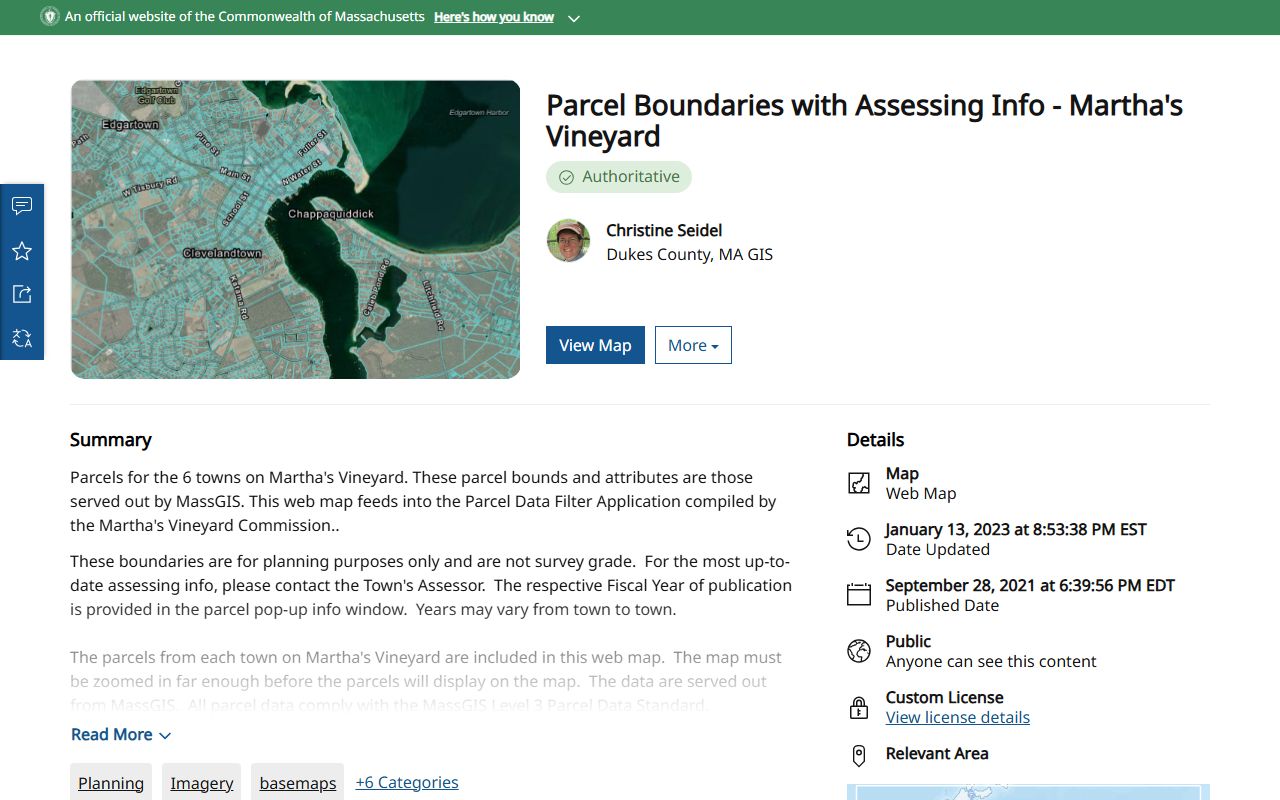
The parcel boundaries update with each revaluation cycle, and the linked data includes land area, building square footage, and the assessed value used for tax billing.
Note: GIS parcel data is for reference; always confirm assessed values with the town assessor before relying on them for appeals or purchases.
Town Assessors Across Dukes County
All seven Dukes County towns have their own assessor responsible for setting property values. Because the island has no cities, everything runs through town government. Here are the contact numbers for each assessor's office:
- Aquinnah: (508) 645-2306
- Chilmark: (508) 645-2102
- Edgartown: (508) 627-6140
- Gosnold: (508) 990-7408
- Oak Bluffs: (508) 693-3554
- Tisbury: (508) 696-4207
- West Tisbury: (508) 696-0101
Under MGL c. 59, §38, every town must assess property at 100% of fair cash value. On Martha's Vineyard, that means assessments can be quite high given the real estate market. Waterfront homes and properties in sought-after areas like Edgartown and Chilmark often carry assessed values well above a million dollars. The assessor in each town is required to revalue all properties at least every three years to stay in line with market conditions.
Gosnold is worth a special mention. It covers the Elizabeth Islands and Cuttyhunk. Very few people live there year-round. The assessor's office operates out of New Bedford at (508) 990-7408 because the island population is so small. Property tax records for Gosnold parcels can be harder to find online, so calling that number is often the best approach.
The West Tisbury Assessor's Office page shows the tools and resources available for looking up property tax records and exemption details in that town.
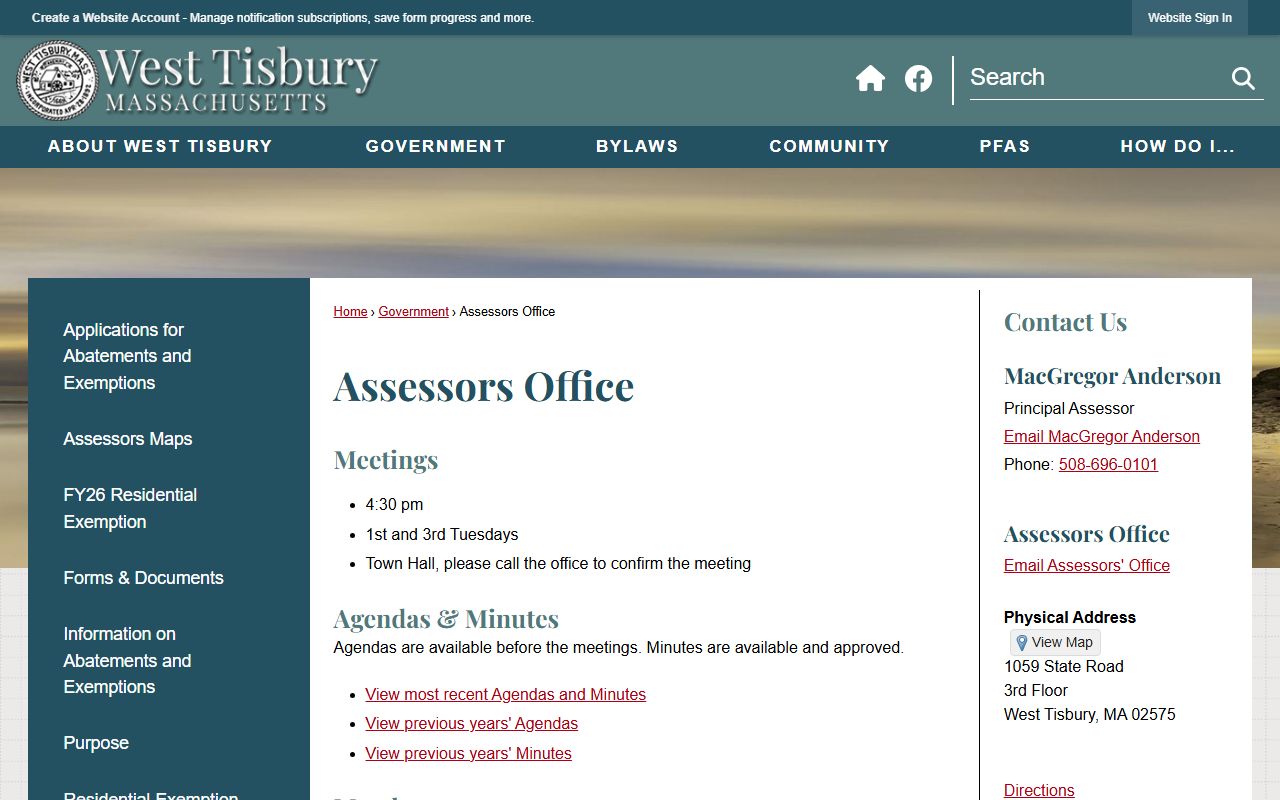
West Tisbury posts assessment data online and provides forms for abatements and exemptions directly on this page.
Residential Exemptions on Martha's Vineyard
Three Dukes County towns offer a residential exemption: Tisbury, Oak Bluffs, and West Tisbury. This exemption shifts part of the tax burden from full-time residents to seasonal and investment properties. If you own and live in the home as your primary residence, you can exempt a percentage of the average residential assessed value from your tax bill. The exact dollar amount changes each year based on the town's average values and the exemption percentage they adopt.
This matters a lot on the Vineyard. Seasonal homes make up a large share of the housing stock. The exemption gives year-round residents a real break because those seasonal properties end up paying a slightly higher effective rate. You apply through your town assessor's office. The deadline is typically April 1 for the current fiscal year. You need to show that the property is your primary home, and the assessor may ask for proof of residency such as a driver's license, voter registration, or utility bills.
Towns that do not offer the residential exemption, like Edgartown and Chilmark, use a single tax rate for all residential properties regardless of owner occupancy. Whether a town adopts the exemption is a local decision made at town meeting each year.
Note: The residential exemption applies only to your primary home; rental properties and second homes do not qualify even if you own them in an exemption town.
Dukes County Tax Payments and Penalties
Property taxes in Dukes County are billed quarterly in most towns. Due dates follow the standard Massachusetts schedule: August 1, November 1, February 1, and May 1. Some of the smaller towns may still use semiannual billing. Check with your town collector to be sure which cycle applies to you.
Payment options depend on the town. Larger towns like Edgartown and Oak Bluffs generally accept online payments through their municipal websites. Smaller towns may only take checks by mail or in person at town hall. Credit card payments, where accepted, usually come with a convenience fee around 2.5%.
Late payments carry 14% annual interest from the due date. That rate is set by state law and applies everywhere in Massachusetts. If taxes remain unpaid, the town can place a lien on the property and eventually pursue a tax taking. On Martha's Vineyard, where property values are high, even a short period of delinquency can result in significant interest charges. Pay on time.
Exemptions and Abatements in Dukes County
Beyond the residential exemption, Dukes County residents can apply for standard tax exemptions under MGL c. 59, §5. Seniors age 65 and older may qualify for Clause 41C, which reduces the bill by $1,000 or more. Veterans with disabilities get relief under several clauses. Blind residents qualify under Clause 37A. Surviving spouses get a modest reduction under Clause 17D.
If you believe your assessment is too high, file Form ABT with your town assessor by April 1. Include comparable sales data, photos, or any other evidence that supports a lower value. The assessor has three months to respond. If you are denied or they do not act in time, you can take the case to the Massachusetts Appellate Tax Board. Most disputes on the Vineyard get resolved at the town level, but the appeal option exists for cases where the numbers do not add up.
The Martha's Vineyard Commission is another resource worth knowing about. While it does not handle taxes directly, it tracks development patterns and land use decisions that affect property values across the island. Their data can sometimes be useful context when preparing an abatement filing.
Nearby Counties
These counties are near Dukes County and have their own property tax records pages.