
Access Peabody Property Tax Records
Peabody property tax records include assessments, ownership data, tax bills, and exemption status for all properties in the city. The Peabody Assessors Office manages these records and offers a public MapGeo portal for online searches. Essex North Registry of Deeds holds the deed and land records for the area. This guide covers how to search Peabody property data, pay your tax bill, and file for relief if you qualify.
Peabody Property Tax Overview
Search Peabody Property Records
The Peabody MapGeo property viewer is the main tool for looking up property tax records. You can search by address, owner name, or parcel ID. The results show assessed value, lot dimensions, building details, and tax information for each parcel. The map interface lets you click on any lot to see its data. Aerial views and parcel boundaries are also available. The tool is free and open to the public. No account is needed.
This screenshot shows the Peabody MapGeo portal where you can enter an address to pull up assessment and property tax details.
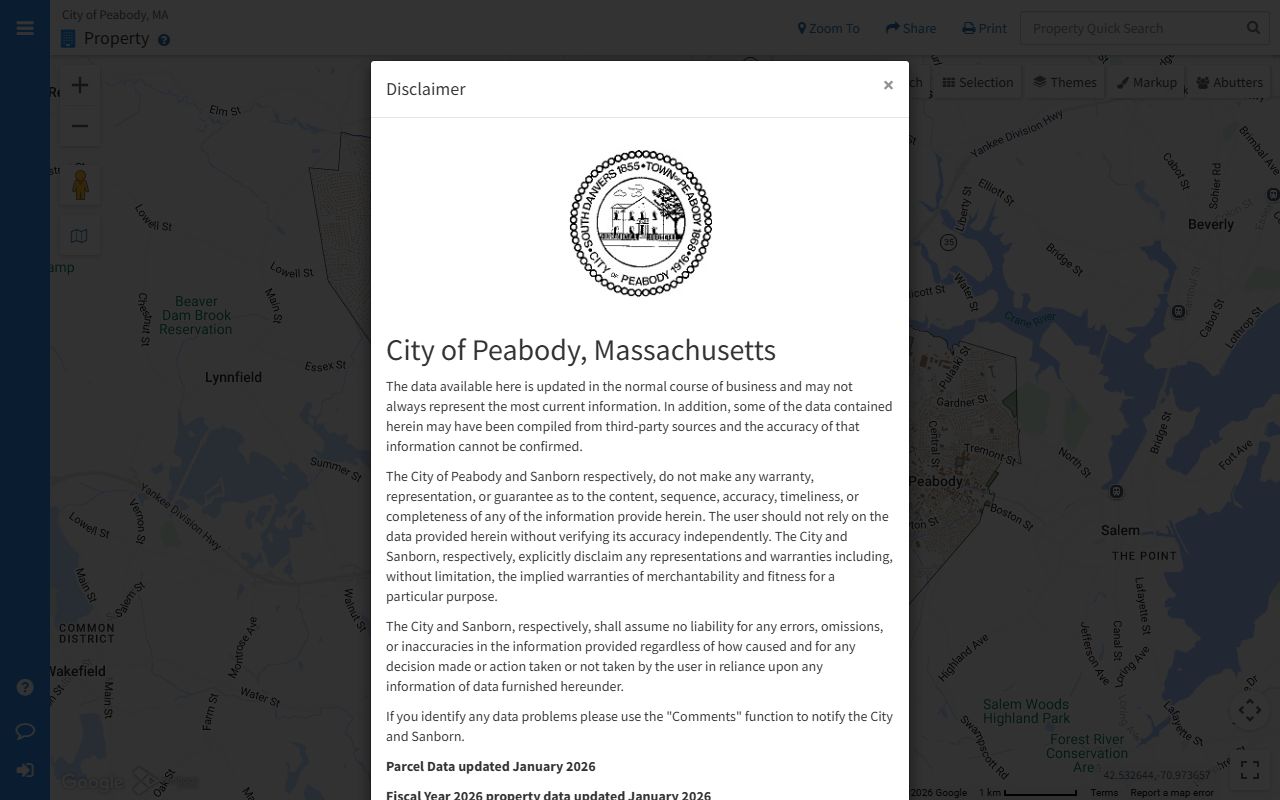
Data in the viewer reflects the current fiscal year. The assessors office updates records as changes are processed.
For FY2026, Peabody's residential tax rate is $9.47 per $1,000 of assessed value. The commercial rate is $18.85 per $1,000. These rates are set each year after the city budget is approved and the total assessed value is certified. Under MGL c. 59, §38, all property must be assessed at full and fair cash value as of January 1 each year. Peabody uses a classified tax system, which means the residential and commercial rates are different. The city votes on this split each year. Commercial properties carry a higher share of the tax burden.
The MassGIS Interactive Property Map also includes Peabody parcels. This statewide tool provides another way to look up property data and compare values across communities.
Note: If you recently bought a property, the new assessed value may not appear until the next fiscal year's data is published.
Peabody Assessors Office
The Peabody Assessors Office is at 24 Lowell Street, Peabody, MA 01960. The phone number is 978-538-5716. The office sets assessed values for every property in the city and processes exemption applications, abatement requests, and property data corrections. Staff can explain how your value was set and what comparable sales or other data went into it. Office hours are Monday through Friday during standard business hours.
Each year, the assessors office reviews property values across the city. Adjustments are based on recent sales, building permits, and physical inspections. If you made improvements to your property, the assessed value may go up to reflect the added value. If the market drops, values should adjust down. The office sends valuation notices before the fiscal year starts, giving you time to review your new value. If you spot an error in your property's physical data, contact the office before the formal abatement window opens. Simple corrections can often be handled quickly.
Peabody's classified tax system means residential and commercial properties are taxed at different rates. The city council votes on this classification each year. The residential rate tends to be lower, which shifts more of the tax load onto businesses and commercial property. This is a common choice in Massachusetts and is allowed under state law. The assessors office posts approved rates on the city website after the vote each fall.
Peabody Tax Exemptions
Peabody offers several property tax exemptions. Senior homeowners aged 65 and older can apply for a Clause 41C exemption, which reduces the tax bill by $1,000 or more depending on income and assets. Veterans with service-connected disabilities receive relief ranging from $400 to a full tax waiver. Blind property owners in Peabody can get an exemption between $500 and $850. Surviving spouses may qualify for a $234.50 reduction. All exemption forms must go to the assessors office by April 1 each year. You must apply annually for most programs.
The Massachusetts Senior Circuit Breaker Tax Credit is also available. Worth up to $2,820, this credit is claimed on your state income tax return. It helps seniors 65 and older with moderate incomes offset their property tax costs. Under MGL c. 59, §5, the state law outlines all available property tax exemptions and their eligibility rules. Each exemption clause has its own income limits, asset tests, and application requirements. The assessors office keeps forms on hand and can help you figure out which programs fit your situation.
A tax deferral program is also available for seniors aged 60 and older. This lets you defer all or part of your tax bill. The deferred amount accrues interest at a state-set rate and becomes a lien on the property. When the property is sold or transferred, the deferred balance is paid off. The interest rate is well below the standard 14% late payment penalty. This option is designed for homeowners who want to stay in place but struggle with current cash flow.
Note: The blind exemption in Peabody ranges from $500 to $850 depending on the specific clause and local adoption. Check with the assessors for the exact amount.
Paying Peabody Property Taxes
Peabody property taxes are due quarterly on August 1, November 1, February 1, and May 1. Late payments trigger 14% annual interest from the due date. The city accepts payments by e-check or credit card online. In-person payments are taken at City Hall. You can also mail a check to the Treasurer/Collector at 24 Lowell Street, Peabody, MA 01960. Credit card payments usually carry a convenience fee. E-check payments may have a lower fee or none at all.
If your assessed value seems too high, you can file for an abatement. Use Form ABT and submit it to the assessors office within the filing window, which is generally 30 days after the third-quarter bill is mailed. If the assessors deny your request, you have the right to appeal to the Massachusetts Appellate Tax Board. Under MGL c. 59, §21C, Proposition 2 1/2 caps the annual increase in the total tax levy at 2.5%. This protects taxpayers from sharp year-over-year jumps. The city can exceed this cap only with voter approval through an override ballot question.
Essex North Registry of Deeds
Deed records for Peabody are recorded at the Essex North Registry of Deeds in Lawrence. The registry handles deeds, mortgages, liens, and other land documents for the northern part of Essex County. You can search records online at massrods.com. The online system covers records going back multiple decades. Viewing is free. Certified copies require a fee paid to the registry.
Property tax records and deed records are closely linked. When a property sells, the new deed is recorded at the registry and the assessors office updates ownership information. If you are researching a property's full history, checking both the assessors database and the registry gives you the most complete view. The registry also records homestead declarations, which cost $35 to file and shield home equity from certain creditor claims under state law.
Nearby Cities
These nearby cities also maintain property tax records with local assessment and payment details.
Essex County Resources
Peabody is in Essex County. The county page has more detail on registry services, assessment tools, and property tax resources across the county.