
Access Fall River Property Tax Records
Fall River property tax records include assessed values, ownership details, billing history, and exemption data for every parcel in the city. The Fall River Board of Assessors manages these records and provides online access through the Patriot Properties search tool. Fall River sits in Bristol County and has its own registry district for deed records. With a median single-family assessed value around $385,588 and a residential rate of $11.45 per $1,000, understanding your property tax situation here is straightforward once you know where to look.
Fall River Property Tax Overview
Fall River Property Record Search
The Fall River Patriot Properties search tool is the main way to look up property tax records online. You can search by address, owner name, or parcel ID. Each result shows the assessed value, property class, land and building values, lot size, and sale history. The tool is free and open to anyone. It does not require an account or login.
Patriot Properties also lets you view detailed property record cards. These cards show building characteristics like square footage, year built, number of rooms, condition rating, and style. This kind of detail matters if you are comparing your property to similar ones in the neighborhood. The system updates with each fiscal year's assessment data, so the numbers reflect the most recent values set by the assessors.
The screenshot below shows the Fall River Patriot Properties portal, the starting point for any property tax lookup in the city.
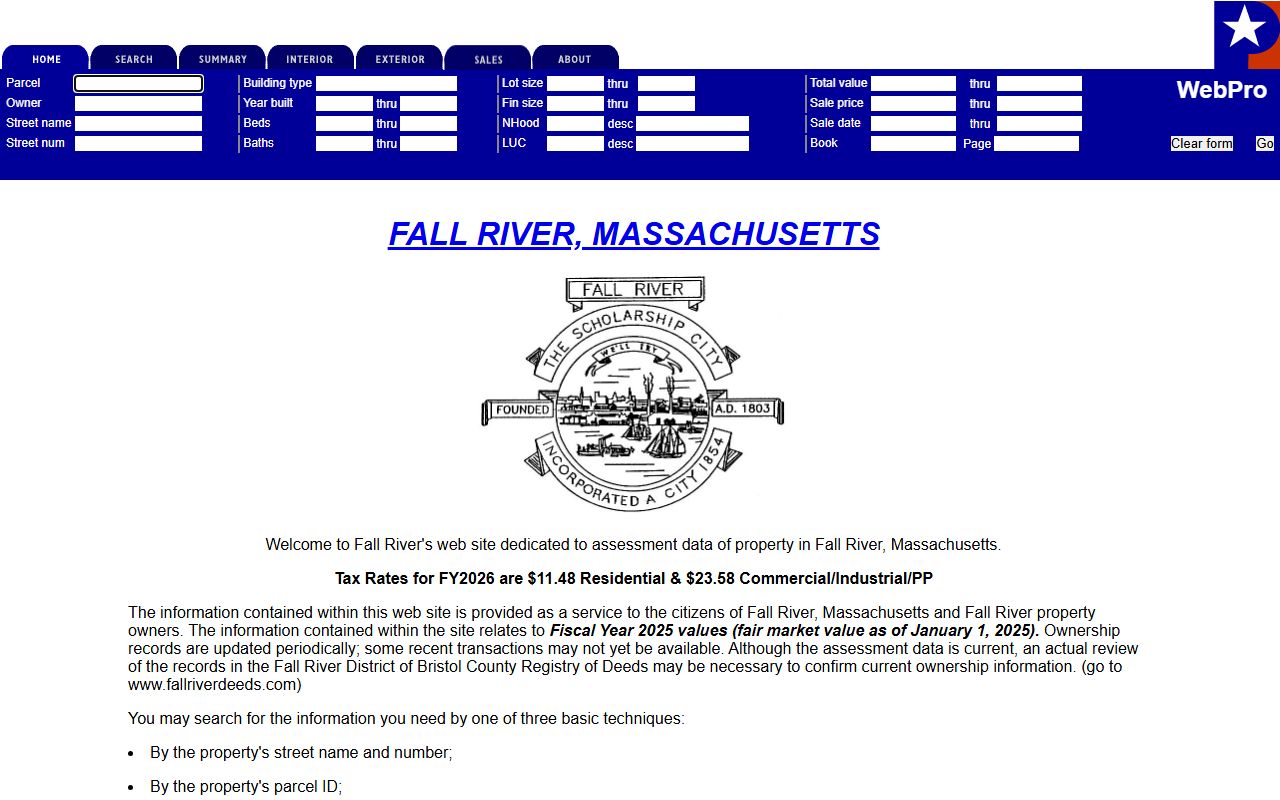
Start your search with just an address. Results come up in seconds.
Note: If a property recently sold, the new owner may not appear in the system until the next assessment update.
Fall River Board of Assessors
The Fall River Board of Assessors is responsible for setting assessed values on all property in the city. You can reach them at 508-324-2300 or by email at boardofassessors@fallriverma.org. The office handles assessment questions, exemption applications, and abatement filings. If you think your assessed value is wrong, this is where you start the process to get it reviewed.
Under MGL c. 59, §38, all Massachusetts property must be assessed at full and fair cash value as of January 1 each year. Fall River follows a classified tax system with separate rates for residential and commercial properties. The FY2025 residential rate sits at $11.45 per $1,000 of assessed value. Commercial properties pay $23.83 per $1,000. A home assessed at the median value of $385,588 would owe about $4,415 per year in property taxes. The commercial rate is roughly double the residential rate, reflecting the city's decision to shift some tax burden onto business properties.
The Fall River city website links to all departments including the assessors, tax collector, and other offices that handle property-related matters. The site is a good starting point if you need to track down a specific form or phone number.
Tax Payments and Deadlines
Fall River property taxes are billed quarterly. Payments are due August 1, November 1, February 1, and May 1. The city accepts online payments through Invoice Cloud. You can also pay by phone at 1-855-801-0769. In-person payments and drop box submissions are available at City Hall. Mailed payments should be sent to the collector's office. E-check payments are free. Card payments carry a convenience fee.
Late payments trigger interest at 14% per year on the outstanding balance. This rate is set by Massachusetts law and applies across all cities in the state. Ongoing non-payment can result in a tax lien on the property, which is a serious problem that affects your ability to sell or refinance. If taxes remain unpaid long enough, the city can begin tax title proceedings. Do not let bills go unpaid. If you are facing a financial hardship, call the collector's office before the due date to discuss payment arrangements.
Proposition 2 1/2 under MGL c. 59, §21C caps the annual increase in the total tax levy at 2.5% plus new growth. This law provides a ceiling on how much Fall River can collect in property taxes each year, regardless of changes in individual property values. It is one of the main safeguards for homeowners against sudden tax spikes.
Exemptions and Abatements
Fall River offers tax exemptions for qualifying property owners. Elderly homeowners may apply under Clause 41C for a reduction. Veterans with a service-connected disability qualify for exemptions that range from a few hundred dollars to a full waiver, depending on the level of disability. Blind residents and surviving spouses also have dedicated programs. Under MGL c. 59, §5, the state sets the rules for each exemption category, and cities like Fall River adopt them locally.
All exemption applications must be filed with the Board of Assessors by April 1 each year. You need to own and occupy the property as your primary home to qualify for most programs. The Massachusetts Senior Circuit Breaker Tax Credit can return up to $2,820 to qualifying seniors through the state income tax return. That credit is filed through the state, not the city.
To challenge your assessment, file Form ABT for an abatement by April 1 or within three months of when bills were mailed. Under MGL c. 59, §59, every property owner can seek a reduction if the assessed value exceeds fair market value. Collect recent sales of comparable properties to support your case. If the assessors deny your abatement, you can appeal to the Massachusetts Appellate Tax Board.
Note: Each exemption type has its own income and asset limits, so confirm current thresholds with the assessors before applying.
Fall River Registry District
Fall River has its own registry district within Bristol County. Deed records are at the Fall River District Registry of Deeds. The registry records property transfers, mortgages, liens, and other title documents. You can search the online database for free. The system covers documents going back many years. When a sale closes, the deed is recorded here and the assessors use that information to update ownership records.
Bristol County is unusual in Massachusetts because it has three separate registry districts: Northern (Taunton), Southern (New Bedford), and Fall River. Fall River properties are recorded at the Fall River district specifically. If you are searching deed records for other Bristol County towns, make sure you are looking in the right district.
The screenshot below shows the Fall River Registry of Deeds online search, where you can look up deeds, mortgages, and other recorded documents.
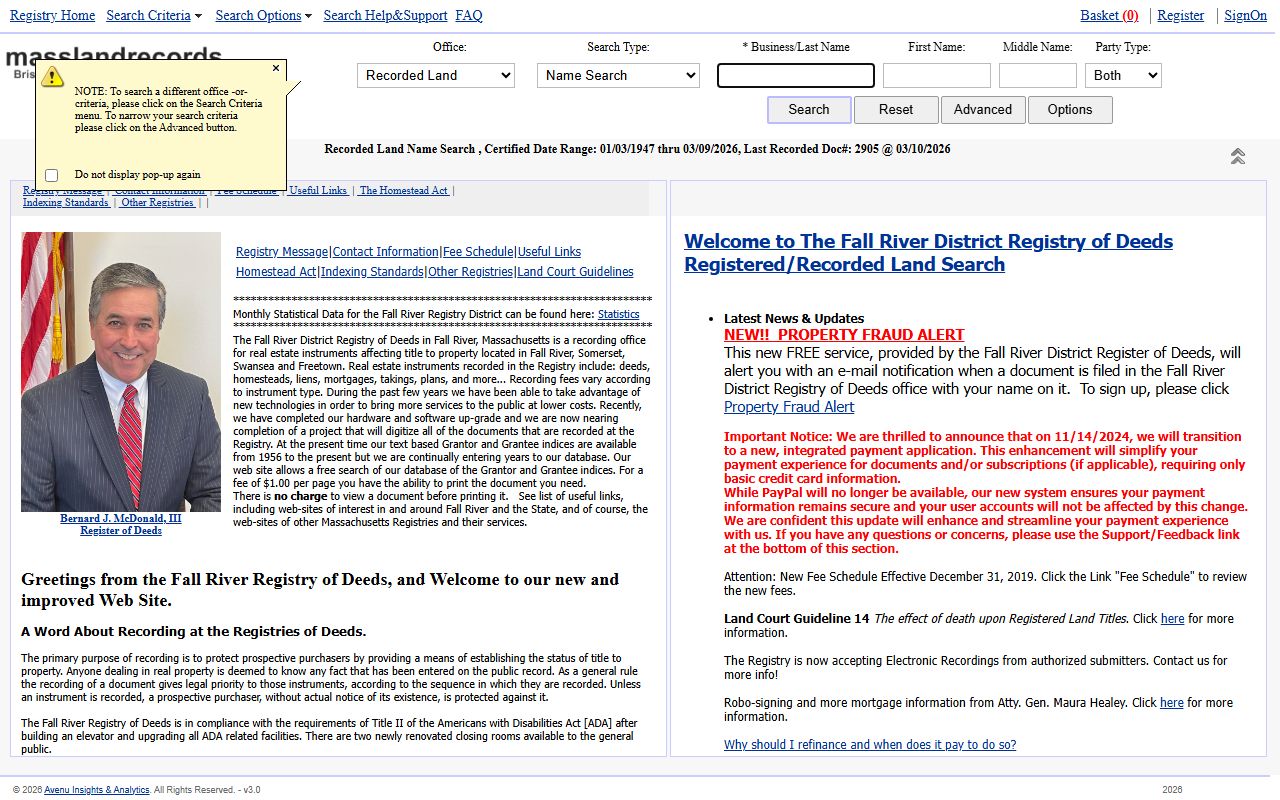
Searches are free. Certified copies require a fee paid to the registry.
Nearby Cities
New Bedford and Taunton are the closest qualifying cities to Fall River, all in the Bristol County area.
Bristol County Resources
Fall River is part of Bristol County. The county page covers all three registry districts and property tax information for towns across the county.